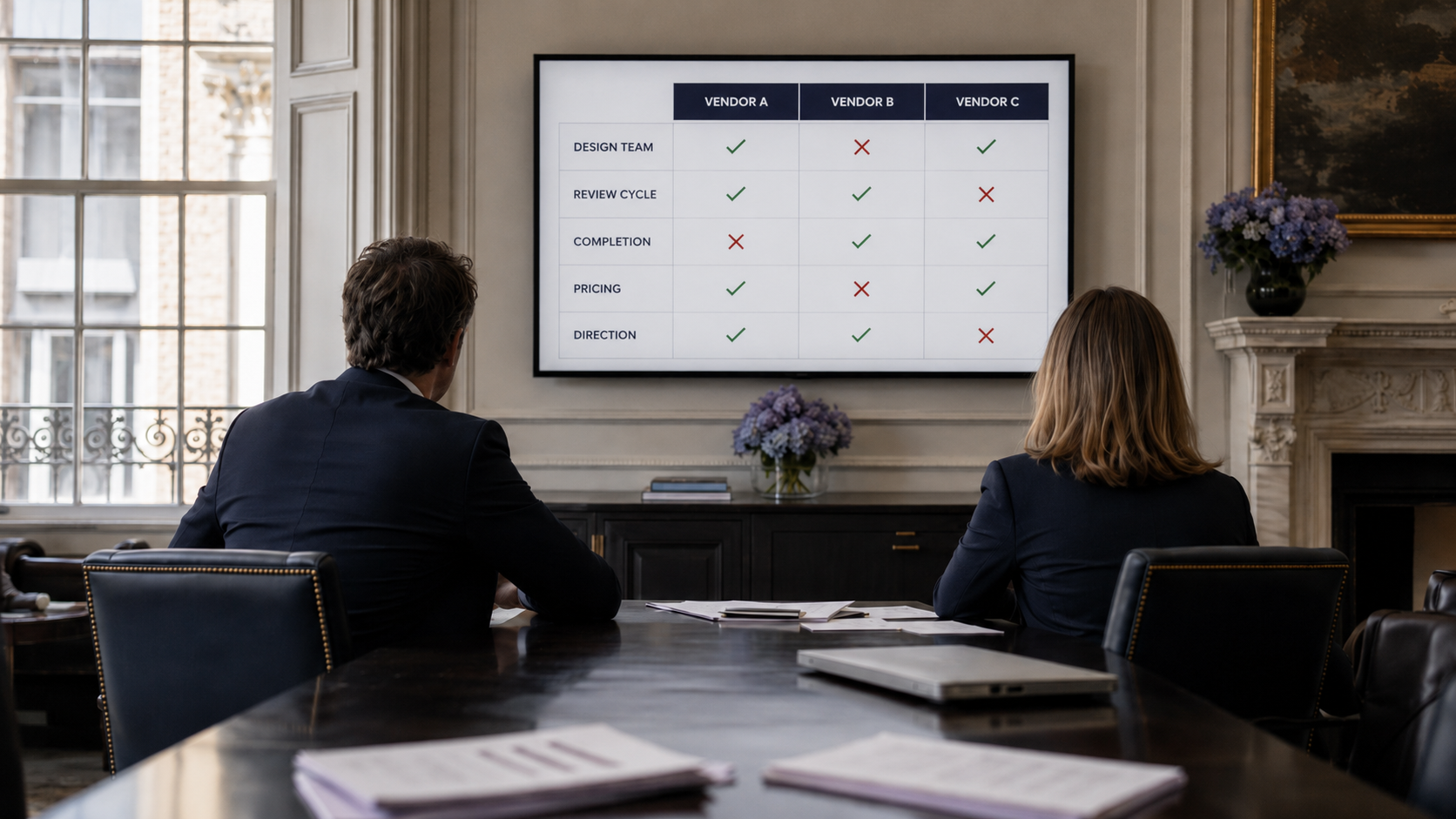
Written for Heads of Learning, Programme Managers, and Directors of Education at professional certification bodies, regulated training providers, and corporate academies who have decided to commission a custom build, and are now staring at a shortlist of providers whose websites all say the same thing.
The decision to partner the build out is supposed to be the hard part. Then the shortlist arrives, and you discover the real problem: every provider on it sounds identical. Custom. Learner-centred. Award-winning. Engaging. Three websites, three capability decks, and not one sentence that tells you who will still be answering your emails in month seven.
This is not an accident. Proposals are optimised to win work, not to predict how the work will go. The sample that dazzles in the pitch may have been built by someone who left two years ago. The senior person presenting may never touch your programme again. The quote that comes in 30% under the others may have quietly omitted the things that make a programme survive contact with real learners. None of this is visible on a website, which is why choosing on websites, or on polish, or on price, is how organisations end up commissioning the same disappointment twice.
The good news is that the differences between providers are real and they are findable. You just have to ask questions the pitch was not built to answer. Here are the five that do the separating, and what the answers tell you.
1. Who actually designs my programme, and can I meet them now?
The most common failure in this market has a name: the pitch-team-to-delivery-team handoff. Senior people win the work; the work is then routed to whoever has capacity. By the time you notice, you are three months in and the person who understood your regulatory context in the pitch meeting has never seen your content.
So ask, in the first conversation: who will do the design thinking on this programme, and can I meet them before we sign? Then ask how many other programmes that person will be running at the same time. A provider with nothing to hide answers in one sentence. A provider who answers with "we have a talented team" is telling you the handoff is coming.
While you are at it, interrogate the samples. Whose work is this, specifically? Is that person still here? Better still, ask the designer to critique one of their own samples, what would they change now? A practitioner who has grown will give you a real answer in seconds. A team showing you borrowed work will change the subject.
2. How do you run the review cycle?
Industry benchmarks put the review cycle on comparable custom builds anywhere between three days and eleven weeks, same work, same quality bar, a twentyfold difference in elapsed time. Uncontrolled revision loops routinely add around 40% to development effort. This single phase is where most programme timelines go to die, and it dies on your side of the fence as often as the provider's: subject-matter experts with day jobs, review documents sent into the void, sign-off treated as a favour to be collected when everyone is less busy.
So the question is not "what is your process?", everyone has a process diagram. The question is: what is your method for managing my experts' time? A serious provider has a concrete answer: review windows scheduled like project resources, live review sessions rather than documents lobbed over the wall, structured rounds with defined scope so round two cannot silently become round six. A provider with no answer to this question has a timeline that is fiction, however confident the Gantt chart looks.
3. What happens to completion after launch?
Most providers' responsibility ends at handover. The programme ships, the invoice clears, and whether anyone finishes it becomes your problem. Given that industry completion rates for standard-issue eLearning are famously dismal, this should be the most discriminating question on the list, and it is the one buyers ask least.
Ask: what do you design differently so that people finish? Listen for specifics. Assessment designed first rather than bolted on at the end. Module lengths set by the shape of the content, not the template. Progress mechanics that respect a professional's working week. Measurement that goes beyond a completion certificate. If the answer is "our content is very engaging," you have learned that completion is not something they engineer. It is something they hope for. Hope is not a deliverable.
Choose the provider whose questions are better than your own. The websites will never tell them apart. The questions will.
4. What does the price include, and what happens when scope moves?
Here is the uncomfortable pattern: the cheapest quote on the table usually re-acquires the difference in change orders. It arrives lean because it has omitted things, a defined revision allowance, assessment development, accessibility remediation, the maintenance plan for year two, and every omission returns later wearing a purchase order.
So make the quotes comparable before you compare them. What exactly is included? How many revision rounds, and what triggers a change order? Who owns the source files at the end? What does maintenance cost in year two, when regulation shifts and the content quietly starts going stale? A fixed fee against a properly scoped specification tells you the provider has done this before and priced the risk. A suspiciously low day rate tells you the risk has been priced in later, by you.
5. Where is the work directed, not where is it produced?
Somewhere on your shortlist there is probably a fully local provider, a fully offshore one, and something blended. The instinct is to treat this as a price-versus-quality slider. That is the wrong axis. The question that predicts outcomes is not where the work is produced but where it is directed: who owns the design decisions, who manages quality day to day, whose judgement your programme depends on, and whether that person operates in your world, your timezone, your regulatory context, your standard of accountability.
Global buyer research bears this out: around 84% of organisations rank quality as the deciding factor in these decisions, and only about a third cite cost as the primary driver. A blended model done properly, senior design direction close to you, production capacity where it is economical, can outperform both extremes. Done badly, with the direction offshore too, it produces the polished-but-wrong work that costs more to fix than it did to build. So ask: who directs quality, where do they sit, and who do I call when something is wrong? The answer should be a name, not a diagram.
The test that takes five minutes
If you only have one first call with each provider, run this test: count the questions they ask you.
A provider who quotes off a phone call is pricing to win, not to deliver. A serious one will refuse to put a number on your programme until they understand the audience, the content estate, the regulatory constraints, the SME availability and the launch drivers, because those are the variables the price actually depends on. The strongest signal on the entire shortlist is the provider who insists on diagnosing before quoting. It is mildly annoying in week one. It is the reason the programme exists in month twelve.
Choose the provider whose questions are better than your own. The websites will never tell them apart. The questions will.
Where LearnFrame comes in
LearnFrame designs and builds digital learning programmes for certification bodies, regulated training providers, and corporate academies, with the design decisions directed from Dublin and production run through our established Cape Town team. We hold ourselves to the questions above, which is why we won't quote a programme off a phone call: the Programme Design Diagnostic is how we diagnose before we price, a fixed-fee, independent read on a single programme that gives you a board-ready diagnosis and a costed build scope, whoever you end up choosing to build it.
Building a shortlist right now? The Programme Design Diagnostic is a fixed-fee, independent read on a single programme, a board-ready diagnosis and a costed build scope, in two to three weeks, and it makes every quote on your table comparable.
If you're one step earlier in the decision, the companion pieces are the build in-house or partner it out decision tool and what a custom eLearning build actually looks like in 2026. See more insights from LearnFrame.