Written for Heads of Learning, Programme Managers, and Directors of Education at professional certification bodies, regulated training providers, and corporate academies who launched a digital programme some time ago and have started to wonder whether it is still saying the right things. If you are not in that room, the next six minutes will not apply, and that is deliberate, because the argument turns on a specific budgeting decision inside these organisations.
The email usually arrives somewhere around month eighteen. A member, partway through the digital version of the institute's flagship programme, has noticed that a module is teaching a rule the regulator changed last year. It is not a dramatic error, a threshold that moved, a framework that was revised, a footnote that no longer matches the current standard. The member is not even annoyed. They mention it almost in passing. But they mention it.
The Head of Learning takes it to the team. The team checks, and the member is right. Then someone asks the question nobody had reason to ask before: how much else is out of date? They look, and the answer is uncomfortable. It is not one module. A handful of them have drifted, each one subtly, each one accurate on the day it launched. None has been wrong long enough to be a scandal. But together they describe a programme that has quietly slipped out of currency.
For a regulated credential, currency is not a feature. It is the entire proposition.
This article is about why a programme that was accurate at launch goes quietly wrong, what that ageing actually looks like when you examine it, and how the institutes that avoid it design and budget differently from the very start.
The budget that ends at launch
The root cause is a budgeting decision wearing the costume of a project decision.
A programme modernisation is scoped, approved, and funded as a build. Content is designed, the platform is chosen, the assessment is written, the thing launches. The budget has a beginning and an end, and the end is the launch. When the build budget closes, the team is reassigned and the project is marked complete. What never gets funded, and, more importantly, never gets named, is the work of keeping the programme current after the applause dies down.
This is rational at every step. A capital project needs a defined end; an open-ended one never closes. The team that built the programme has a backlog of other work. The platform is live, the content is accurate, the credential is defensible. By every measure visible at launch, the job is done.
What that view cannot see is that one decision was quietly skipped. In our framework it is the one we call Ownership and Lifecycle: when does this content age, who maintains it, and who owns the editable source files? It is a strategic decision, not a procurement detail. Left unmade, it does not disappear. It gets made by default, eighteen months later, by whichever member happens to notice first, and at the worst possible moment for the institute's credibility.
What ageing actually looks like
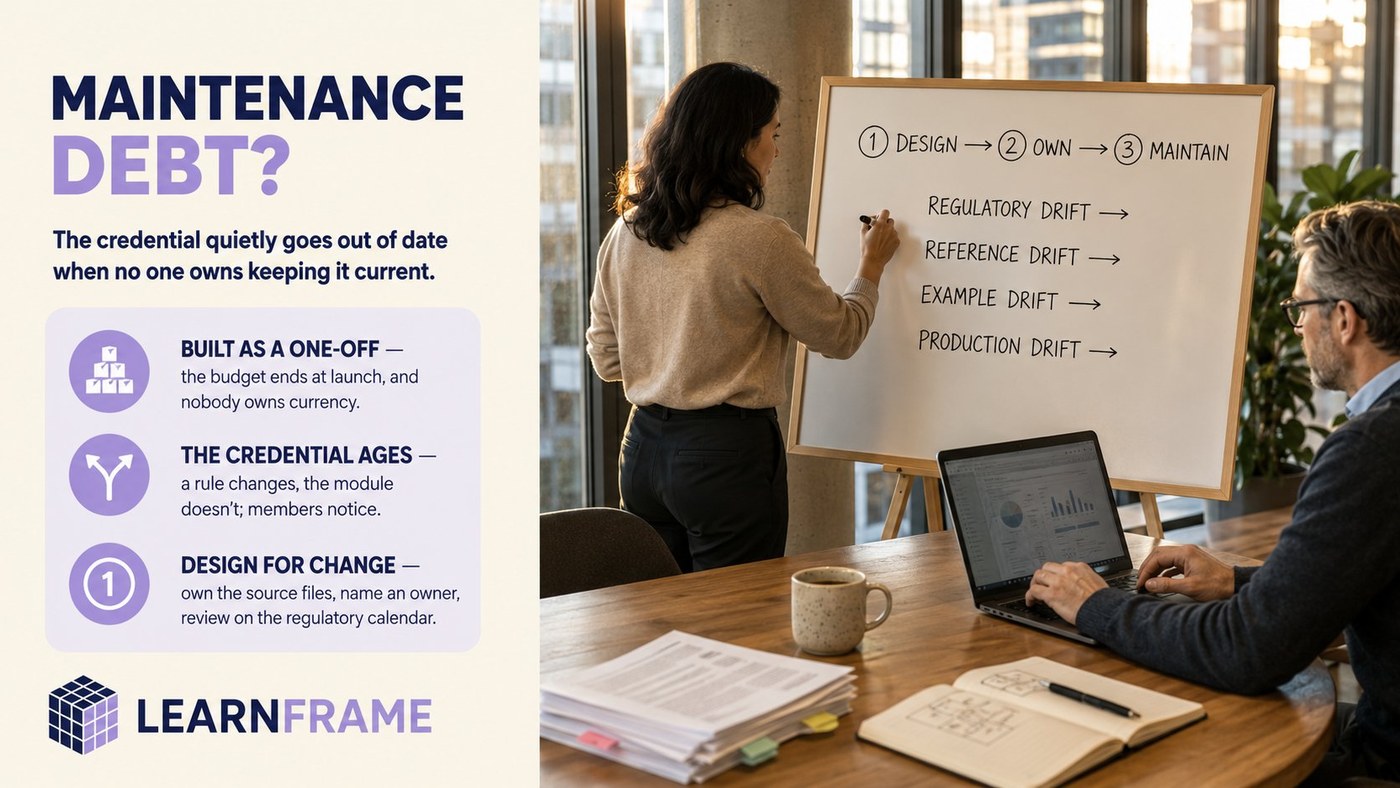
Maintenance debt, examined closely, accumulates in four recognisable forms.
The first is regulatory drift: a rule, limit, or obligation changed, and the module that teaches it did not. This is the most dangerous form, because the credential's whole claim is that it certifies current competence.
The second is reference drift: the standard, syllabus, or professional framework the modules are built around has been revised, and the programme still teaches the previous edition. Nothing in the module is factually wrong on its own terms. It is simply describing a world that has moved on.
The third is example drift: the worked examples, scenarios, and case studies assume the old thresholds, the old rates, the old market. The principle still holds, but every concrete illustration quietly signals "this was written a while ago," and members notice the smell of age before they can name the cause.
The fourth is the subtle one, production drift. The very richness that made the programme impressive at launch is what now makes every correction expensive. A regulatory change that should be a five-minute text edit instead means re-recording a presenter, re-rendering an animation, or re-commissioning a custom illustration. So the correction is deferred, then deferred again. Heavy production on content that changes often is not a sign of quality. It is a maintenance trap, set at build time and sprung months later.
Most underperforming programmes carry two or more of these. Each is invisible at launch. Each is obvious to a member within a single cohort. And each compounds in member word-of-mouth faster than the institute can quietly correct it.
Designing for change from the start
The fix is not more diligence at launch. A programme cannot be inspected hard enough at go-live to stay current for three years; the world will not cooperate. The fix is to design and budget for change from the outset, through three deliberate choices.
The first is to calibrate production to the lifecycle. For content that updates frequently, most regulated content does, lower-richness production is often the right answer, not the lazy one. The question is not "what would look most impressive?" but "what will this cost to put right when the rule changes, as it will?"
The second is to own the source files. The institute should hold the editable source files, the brand assets, and any custom illustration at the end of the engagement, so the in-house team can make small updates without raising a change request. A supplier should provide capacity, not a permanent dependency on someone else's hard drive for every footnote.
The third is to name an owner and a cadence. Someone, by name, owns currency, not the project, not the supplier, a person with the standing to insist the work gets done. And the review cadence is tied to the regulatory calendar rather than to whenever a member happens to email. Programmes built this way age slowly and update cheaply. The ones built as a one-off event start eroding the day the world moves, and they are back for a full rebuild inside three years.
A maintenance diagnostic
For a Head of Learning looking at a live programme, the diagnostic is six questions.
Six questions for a Head of Learning
First, for each module, can the team say when its content was last verified against the current rule, standard, or framework, and against which version?
Second, who, by name, owns currency? If the answer is "the team" or "the supplier," no one does.
Third, does a review cadence exist, and is it tied to the regulatory calendar, or to chance?
Fourth, does the institute hold editable source files, or does every correction depend on a supplier change request?
Fifth, for the modules most likely to change, was production calibrated to the update frequency, or does a minor regulatory tweak mean re-shooting video?
Sixth, if a member or a regulator flagged out-of-date content tomorrow, how long would it take to put right, and how much would it cost?
A team that can answer six of six confidently is rare. Four of six is a working benchmark. Fewer than three, and maintenance debt is already accruing, whether or not the cohort has surfaced it yet.
Why this matters more in 2026
Three forces are converging to make this more expensive than it used to be.
The pace of regulatory change is rising, not falling. Financial services, the EU AI Act, sustainability and ESG reporting, data protection, rules that once moved on a multi-year cycle now move yearly, sometimes faster. The half-life of "current" content is shortening across every regulated sector at once.
The professionals passing through these credentials are fluent in comparison and quick to spot age. They have a well-maintained app on their phone updating every fortnight. The moment an institute's programme teaches last year's rule, the credential is worth a little less in their eyes, and members talk, to each other and to the council.
And credentials are more visible than they were. Members move between employers, sectors, and borders, and a stale programme follows them as a quiet liability the institute can no longer treat as an internal inconvenience. The cost of maintenance debt is not only member dissatisfaction. It is competitive.
Where LearnFrame comes in
Ownership and Lifecycle is one of the five module decisions in the Programme Design Decision Guide, a framework for organisations evaluating a custom eLearning development engagement, written to be useful whoever ends up building the work. LearnFrame designs and builds digital learning programmes for professional certification bodies, regulated training providers, and corporate academies, strategic direction from Dublin, production capacity through an established Cape Town team, and structures every engagement so the institute ends up owning the outcome and the maintenance, not a permanent supplier dependency.
The last programme your institute launched: who, by name, is responsible for keeping it current, and when is it next due to be checked against the rules it teaches?
Related definitions: maintenance debt · credential drift · assessment-first design
Weighing a decision like this on one of your own programmes? The Programme Design Diagnostic is a fixed-fee, independent read on a single programme, a board-ready diagnosis and a costed build scope, in two to three weeks.
This article pairs with a shorter Field Notes post on the same pattern. See more insights from LearnFrame.