Written for Heads of Learning, Directors of Education, and Programme Managers at certification bodies, regulated training providers, and corporate academies who are about to commission a custom build for the first time, and are being sold a story about how fast and cheap AI has made it.
If you run learning at a certification body, a regulated training provider or a corporate academy, you don't commission custom builds often. Which means that when you finally do, a new qualification, a CPD scheme to digitise, a mandatory programme the regulator now expects online, you're making a six-figure decision on a process you've mostly only seen from the outside.
And right now that outside view is being reshaped by a very loud story: that AI has made custom eLearning fast and cheap. What used to take three months now takes three weeks. It's a real claim, and there's truth in it. But it describes only one part of the work, and if you plan your budget, your timeline and your team's involvement around it, it's the part most likely to mislead you.
Here's what a custom build actually looks like from your side of the table, and where AI genuinely helps versus where it quietly doesn't.
The shape hasn't changed, only one segment of it got faster
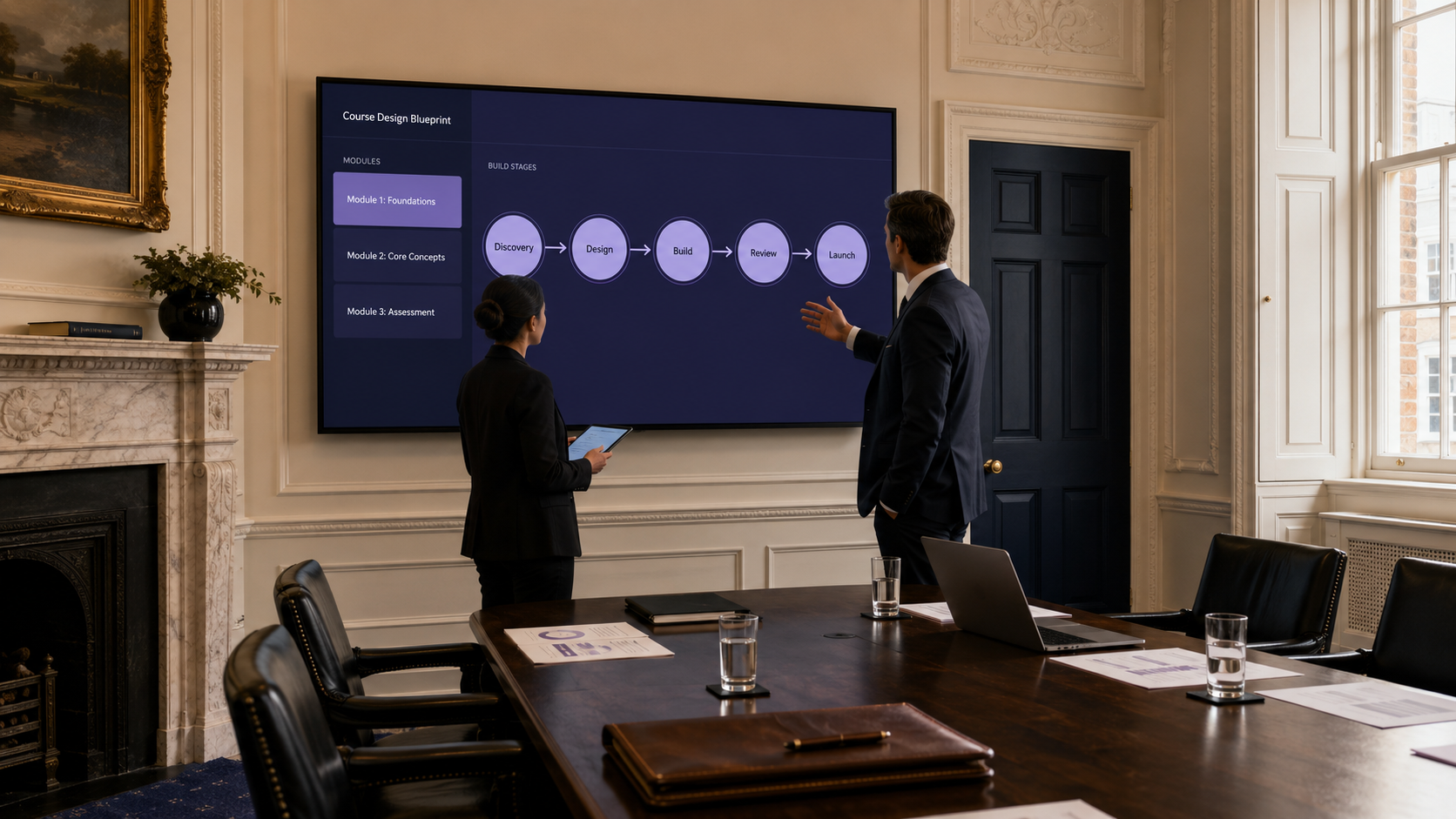
A custom programme moves through a sequence that has been stable for two decades: analysis (what does this need to do, for whom, against what standard), design (how the learning is structured, sequenced and assessed), knowledge extraction (getting what's in your experts' heads into a usable form), production (building the modules, media and interactions), review (your SMEs and leadership checking the work), assessment and completion engineering (making sure people finish and that the credential means something), and launch on your LMS.
The numbers behind that have always been sobering. Widely-used benchmark data, the Chapman Alliance study, still the industry reference for estimation, alongside separate ATD research, puts a single finished hour of interactive eLearning at somewhere between roughly 70 and 220 hours of team effort, rising past 700 hours for advanced, simulation-heavy work. A twenty-hour programme for a regulated body is not a three-week job in any serious sense. Priced realistically, it's a low-six-figure investment on a multi-month calendar.
AI compresses the building. It doesn't compress the deciding, and the deciding is where the quality lives.
Where AI actually lands
The honest version: AI has genuinely compressed production, the middle of that sequence. Drafting outlines, scripts, first-pass assessment items, variant scenarios, localisation: the tasks that used to consume the most hours now move far faster. The 2026 research bears this out, the large majority of L&D teams now report using AI in their work, and the clearest, most consistent gain they name is time saved in content creation, with reported savings on that segment in the region of 40 to 60%.
But notice what that segment is. AI compresses the building. It does not compress:
What AI doesn't do for you
Analysis. Deciding what the programme must actually do and prove. Still human judgment.
Knowledge extraction from your SMEs. The single most underestimated cost in any build, and one AI can assist but not replace, because the knowledge lives in people who are busy.
The review cycle. The part that most often blows the timeline.
Assessment integrity and completion. The difference between a programme people finish and trust, and one they click through and forget.
The bottleneck didn't disappear. It moved, from production capacity to design judgment and your experts' availability. Which is exactly why the "three weeks" story is risky to plan around: it's true for the one phase that was never really your risk.
The three things that actually decide whether it's good
If you're commissioning for the first time, these are the parts worth your attention, because they're where good builds separate from expensive disappointments.
1. The review cycle is your real timeline, not the build. Ask any experienced developer what wrecks a schedule and it isn't the software. It's review. A single content review can run anywhere from three days to eleven weeks depending on how available your reviewers are, and revisions left uncontrolled can add around 40% to total development time. A good partner builds review deadlines, round limits and escalation into the contract before a line is written. If they don't raise it, you'll find out the hard way.
2. SME time is the cost nobody quotes you. Your subject-matter experts are the source material for the entire programme. Their hours never appear on the invoice, but they are the real constraint. A build that assumes your people will turn feedback around in two days when they have day jobs is a build that will slip. Plan for it, protect their time, and treat a partner who helps you extract knowledge efficiently as worth more than one that's simply cheaper per module.
3. Completion and assessment are engineered in, not bolted on. For a certification or CPD programme this is the whole point: the credential has to mean something, and people have to actually finish. Neither happens by accident, and neither is something AI hands you. It comes from design decisions made early, how the programme is sequenced, where assessment sits, how motivation is carried when nothing external forces completion. Get it wrong and you've built a handsome thing nobody completes.
What commissioning well looks like
You don't need to become an instructional designer to buy a good programme. You need to ask the questions that reveal whether a partner understands the shape above.
A few that cut through: How do you control the review cycle, and what happens when it slips? How much of my SMEs' time will you actually need, and how do you make that time efficient? Where does assessment sit in your design, and how do you build for completion rather than assume it? And, the 2026 question, where exactly are you using AI, and where are you deliberately not?
The answer to that last one tells you the most. A serious partner in 2026 uses AI hard on production and not at all on the judgment. One that pitches AI as the whole story is selling you the three-week fantasy, and quietly leaving the parts that determine quality to chance.
The bottom line
A custom build in 2026 is faster than it was, genuinely, in the place where AI does its work. But the parts that decide whether your programme is any good, and the parts that actually consume your calendar, are the same ones they've always been: getting the design right, getting knowledge out of your experts, controlling the review, and engineering the thing to be finished and trusted.
Where LearnFrame comes in
LearnFrame designs and builds custom eLearning programmes for certification bodies, regulated training providers, and corporate academies, end to end, with the strategy and design decisions directed from Dublin and production run through our established Cape Town team. That's how we use modern production speed without letting it dictate the design: the deciding stays senior and deliberate, the building moves fast. If you're weighing a build and want a straight read on scope, timeline and what it'll ask of your team, the Programme Design Diagnostic is a good place to start.
Weighing a decision like this on one of your own programmes? The Programme Design Diagnostic is a fixed-fee, independent read on a single programme, a board-ready diagnosis and a costed build scope, in two to three weeks.
If completion is the problem on your desk specifically, the companion pieces are why custom builds still stall on completion and completion in regulated finance CPD. See more insights from LearnFrame.