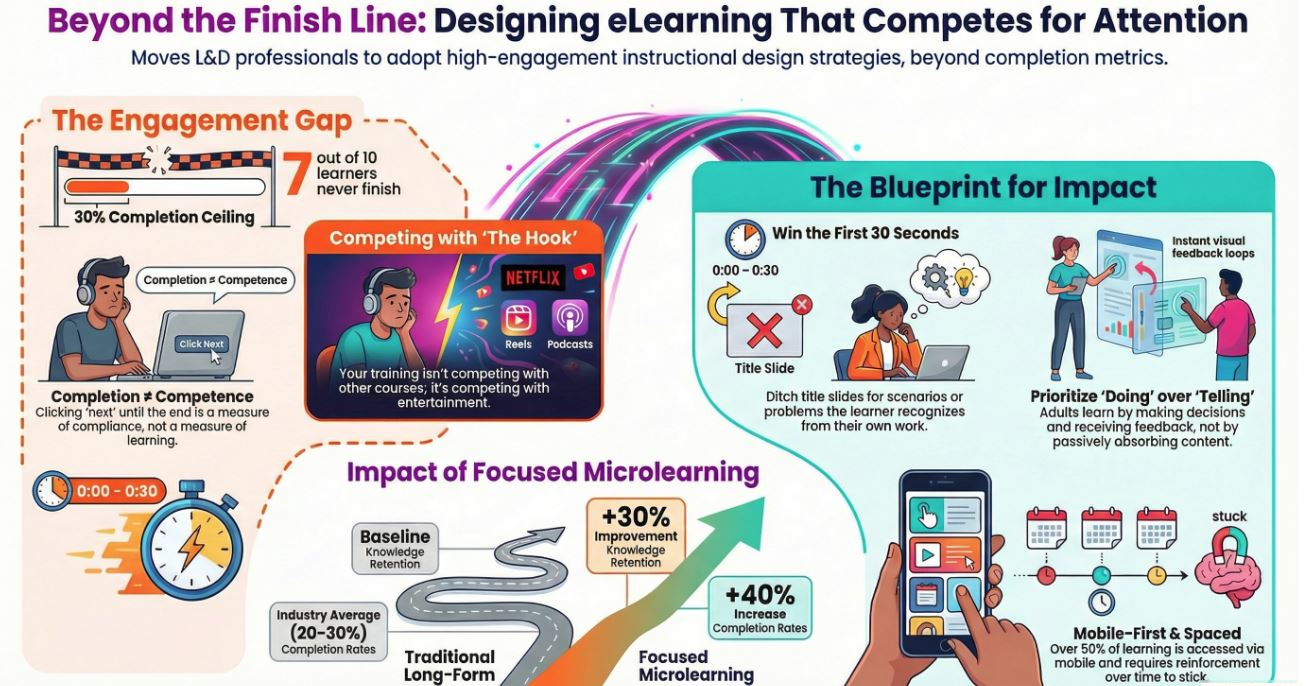
There's a stat that should stop every learning professional in their tracks. The industry average completion rate for corporate eLearning sits somewhere between 20% and 30%. That means for every ten people who start an online course at work, seven or eight don't finish it.
The instinct is to blame the learner. They're busy. They're distracted. They don't prioritise development.
But that diagnosis is too convenient. And increasingly, the evidence points somewhere else entirely.
Your learners aren't distracted. Your learning is being outcompeted.
An article published this week by Edufic Digital put it better than most: your eLearning isn't competing with other training. It's competing with Netflix. With YouTube. With 30-second Reels that hook you in the first three seconds. With podcasts that make complex ideas feel effortless. With apps designed by behavioural scientists who understand engagement better than most instructional design teams.
Every day, your learners experience content that is beautifully paced, emotionally intelligent, and ruthlessly edited for attention. Then they open their company's training platform and see: "Welcome to this training module. Please click next to continue."
That's not a fair fight. And completion rates reflect it.
Completion was never the right metric anyway
Here's what makes this worse. Most organisations measure the success of their digital learning by whether people finished it. But completion doesn't tell you whether anyone learned anything. It tells you who clicked through to the end.
There's a meaningful difference between a learner who engaged with the material, wrestled with a scenario, practised a skill, and walked away with something they can use, and a learner who clicked "next" seventeen times while checking their email.
Both show as "complete."
The organisations getting real value from digital learning have moved beyond completion. They measure behaviour change. They track whether people can apply what they learned. They look at performance indicators that shift after training is delivered.
But none of that is possible if the learning itself isn't designed well enough to hold attention in the first place.
What well-designed digital learning actually looks like
This isn't about making training entertaining. It's not about adding animations or turning everything into a game. The difference between eLearning that works and eLearning that gets abandoned usually comes down to a few design decisions made right at the start.
It opens with something that matters. Not a title slide and a list of learning objectives. A question. A scenario. A problem the learner recognises from their own work. The first thirty seconds set the tone for whether someone stays or leaves, just like the first thirty seconds of a YouTube video.
It respects the learner's time. Well-designed programmes are ruthlessly edited. Every screen has a purpose. Every interaction earns its place. There is no padding, no unnecessary repetition, no content included simply because someone in the approval chain thought it should be there. When one company replaced its long-form courses with focused microlearning modules, completion rates jumped by 40% and knowledge retention improved by 30%.
It's built around how adults actually learn. Adults don't learn by being told things. They learn by doing things, by practising, making decisions, getting feedback, and trying again. The best digital learning puts the learner in situations that mirror their real work and asks them to think, not just absorb.
It works on the device they're already using. Over half of all digital learning is now accessed on mobile. If your programme was designed for a desktop browser and hasn't been adapted, you're losing learners before they even start.
And it's designed as a journey, not an event. A single course, no matter how good, fades quickly without reinforcement. The most effective programmes are structured as learning paths, short, spaced, and connected to what the learner does between sessions.
The gap between "going digital" and "going digital well"
Last week, we wrote about organisations that have the expertise but don't know how to get started with digital learning. This week's point is the natural follow-on: starting isn't enough. The quality of what you build determines whether it works.
The technology is not the issue. There are excellent platforms available at every price point. What makes the difference is the instructional design, the thinking that goes into how content is structured, how learners interact with it, and how outcomes are measured.
A 200-page compliance manual doesn't become effective training just because you turn it into a PDF with a quiz at the end. A two-hour classroom session doesn't become good eLearning just because you record it as a video. The medium changed. The design didn't.
Where LearnFrame fits
At LearnFrame, this is where our custom eLearning development work begins.
We don't just help organisations move their training online. We help them redesign it for the digital environment, structured around how people actually learn, built for engagement, and measured by outcomes that matter.
We've been doing this for over 30 years. And the pattern we see most often isn't a lack of content or a lack of technology. It's a lack of design.
If your digital learning exists but isn't delivering, that's a conversation worth having.
Weighing a decision like this on one of your own programmes? The Programme Design Diagnostic is a fixed-fee, independent read on a single programme, a board-ready diagnosis and a costed build scope, in two to three weeks.