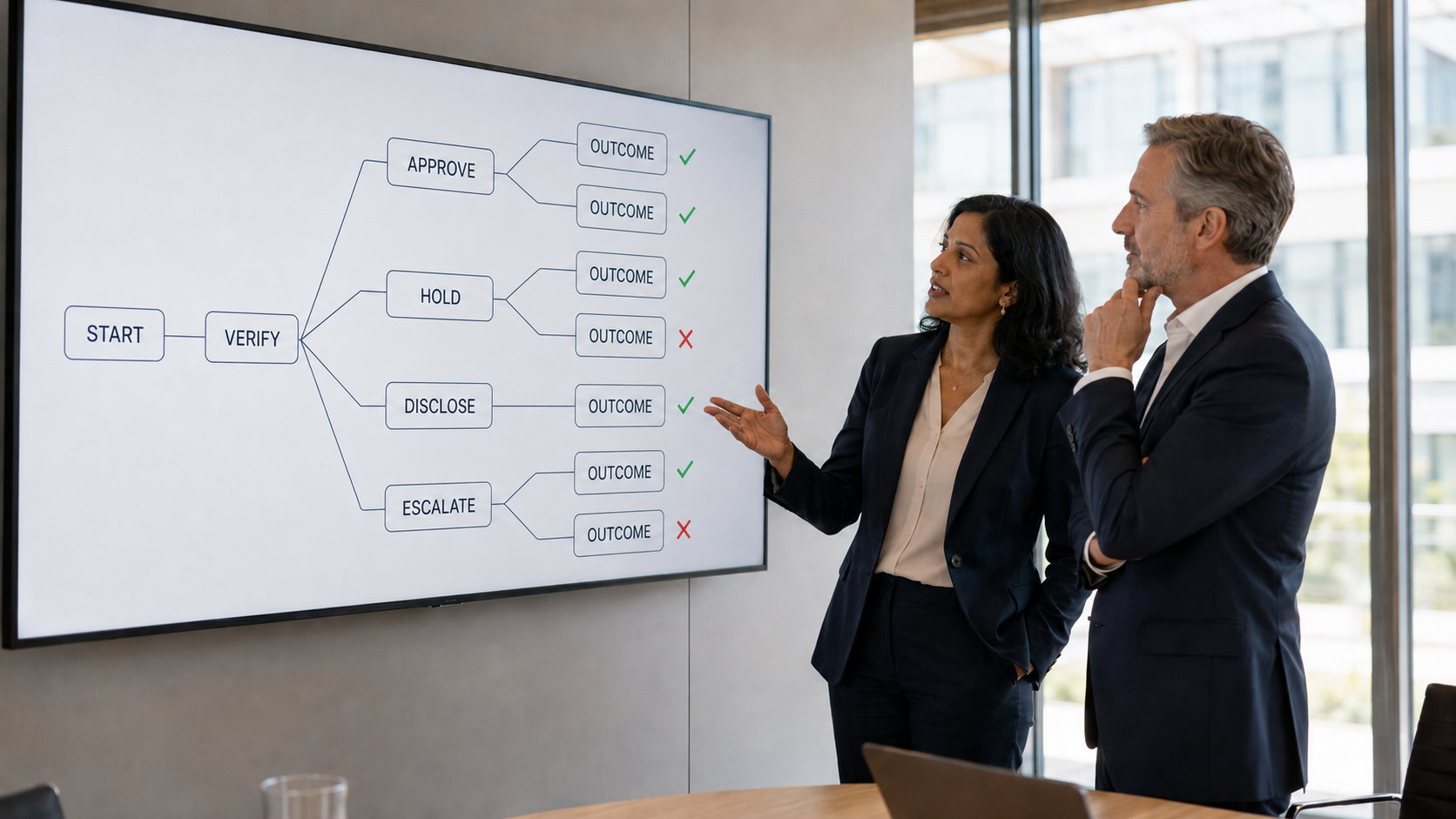
Why decision-based learning was rationed for a decade, what AI actually changed, and the one number worth arguing about.
Before you read any further, go and play Lifesaver. It is free, it needs no registration, and it takes about ten minutes. It is at life-saver.org.uk.
You are dropped into a filmed emergency. Someone has collapsed. You have to decide what to do, and you have to decide now, because the film does not wait for you. Get it wrong and you watch what your decision costs before you are allowed to go back and try again.
It was made by Resuscitation Council UK, the medical charity that writes the official UK guidelines for CPR, the ones the NHS and the first aid charities follow. It is not a marketing piece. It is how a professional body teaches the public to save a life.
And it works. A randomised controlled trial published in the journal Resuscitation compared schoolchildren who used Lifesaver on its own against children who had face to face training. On several of the key elements of successful CPR, the two groups came out comparable. Since 2023, completing all four Lifesaver scenarios is enough to register as a cardiac responder with GoodSAM, so an emergency service will alert you to a cardiac arrest near you. Before that, only people with formal first aid training could sign up.
Read that last part again. Finishing a piece of digital learning is now the gate to a real responsibility with real consequences.
Lifesaver launched in 2013.
So why is everything else still a slideshow?
This is the question that ought to bother our industry more than it does.
The answer is not that nobody knew decision-based learning was better. Everybody knew. The answer is that Lifesaver was extraordinarily expensive to make, and there was no way to make it cheaply.
It was built with the production company UNIT9, written and directed by Martin Percy, a BAFTA winner, with a cast that included Daisy Ridley shortly before Star Wars. Every path through it had to be filmed. Every wrong decision needed its own consequence, shot on a set, with actors.
That is the economics of branching, and they are brutal. Every decision point multiplies the work. One development cost guide published this year puts the drivers plainly: branching logic adds serious design time because each decision needs several scripted paths, and a well built scenario often carries six to twelve decision points for a single objective. The same guide notes what happens when someone changes their mind late. A script edit that costs a couple of hundred at the storyboard stage costs roughly ten times that once the line has been recorded, animated and tested.
So the maths did the deciding. A charity with a life or death mission and a donated creative team could justify it once. A certification body updating its ethics module could not justify it at all.
And here is the part the industry does not say out loud very often, so it is worth repeating that one of its own publications did. Branching scenarios have long been a favourite kind of project for suppliers, because the complexity guarantees a large budget. For that same reason, many organisations quietly gave up on them and settled for linear courses that everybody involved knew were less effective.
A page turner is not a design choice. It is what you get when the good version is priced out of reach.
What actually changed
Not the capability. The capability has been there since 2013, and honestly since long before that. Aviation and surgery have trained people this way for decades.
What changed is the price of a branch.
Writing forty paths instead of four used to mean forty times the writing. It does not any more. That is real, and I would not pretend otherwise, because I have just done it.
But I want to be precise about what got cheaper, because there is a lot of nonsense being sold on the back of this. AI compresses the writing and it compresses the production. It does not compress the deciding. It only speeds up someone who already knows what a good decision looks like, because every path it drafts still has to be judged, corrected, scored and stood behind. Hand the same tools to someone without that judgement and you get forty paths of confident, plausible, useless material, faster than ever before.
The advantage is not the tool. Anyone can buy the tool. The advantage is knowing which forty paths were worth writing.
The dungeon master problem
I keep coming back to Dungeons and Dragons, which is where a lot of people my age first met this idea without noticing.
Here is the thing everybody misremembers about it. The game is not infinite. The dungeon master does not invent the world while you play. The world is written in advance, the rules are fixed, and the consequences are decided before anyone sits down. What varies is the route, because you and your friends choose differently.
That distinction is not nostalgia. It is the whole commercial and regulatory argument.
A pre-written, countable set of routes can be listed, inspected, scored and checked. Somebody decided in advance what each choice means and what it costs. If a professional body needs to defend a certificate to an assessment lead, an auditor or a court, that is a document they can point at.
A set of routes generated on the fly cannot be inspected, because until a learner triggers it, it does not exist. You cannot audit something that has not been written. That matters more every month, because when an assessment adapts itself and decides whether someone is certified, European regulators now treat that as a high risk use, with the obligations that follow.
So the version that is cheap to make and the version that is defensible to award are not the same thing. The countable one is both.
The number
In July we published Module 1 of a course called AI for Professional Practice. It is free, it takes about twenty minutes, and it ends in a simulated afternoon where you make five decisions under a clock that does not stop.
There are 486 possible routes through that afternoon. Not an estimate. Every one of them was written, scored and checked.
That is not a big number, and I would rather say so than dress it up. A generative system would produce more routes in a second than we wrote in a week. The number is small precisely because a person had to decide, for each option on each decision, what a competent professional would do and what a poor call should cost. The ceiling is judgement, not computing power.
Now the part that makes the argument for me better than any argument could.
The defect we found in our own course on launch day
On the day we launched, we modelled all 486 routes before making any changes, and found that two of them were broken. In those two runs, a learner who approved and sent a client briefing containing a fabricated source still received a certificate, landing exactly on the pass mark.
That is the precise failure the module exists to prevent, and it was certifying it. The cause was ordinary and boring: a simple points total let strong performance on four duties buy off outright failure on the fifth.
We closed it that day. Five failures are now hard lines that no score can buy back, whatever the total.
The reason we found it at all is that there were 486 routes rather than an unlimited number. We could list them, run them, and look.
You cannot do that with a system that writes the paths as it goes. Not because the technology is bad, but because there is nothing to enumerate.
The hard part is not the branches any more
If you take one practical thing from this, take this.
The reason almost no workplace course is worth doing twice is not that branching was expensive. It is that most courses have one right answer, and once the learner has found it there is no reason to come back.
Replay value needs real dilemmas. Situations where two competent people who both know the rules would do different things, and where the cost of being wrong is genuinely uncomfortable. Those do not come out of a content library or a generative tool. They come out of your own difficult cases, the ones your members ring you about, the ones that ended badly.
AI has made the branches cheap. It has not made the dilemmas, and it never will, because the dilemmas are the thing your organisation knows and nobody else does.
That was always the valuable part. It is just that until recently, the cost of the branches hid it.
If you commission programmes and you have previously been told scenario work was out of budget, that answer is now out of date. Ask again. Then ask the harder question, which is who is going to sit down and decide what the difficult decisions actually are.
Module 1 of AI for Professional Practice is free and open. Play it, and try to find the two routes we broke. You will not, because they are fixed, but you will see why they were findable. Start Module 1.
Wondering whether one of your own programmes could carry real decisions rather than a Next button? The Programme Design Diagnostic is a fixed-fee, independent read on a single programme: a board-ready diagnosis and a costed build scope, in two to three weeks. Where the recommendation is to build rather than buy, see how custom eLearning development works at LearnFrame.
For what a build actually involves once you commission one, see what a custom eLearning build actually looks like. For the prior question of whether to build at all, see custom eLearning versus off the shelf. See more insights from LearnFrame.