Between now and 2 August, something about the EU AI Act will land in your inbox that is confidently, fluently wrong.
It might claim a literacy deadline that was softened weeks ago. It might quote a fine that doesn't attach to the obligation it's bolted onto. It might be assembled, as these things now are, from real fragments: a real article of the Act, a real penalty figure, a real date, combined into a claim that stopped being true before most organisations had heard of it. The information environment around this legislation has become so noisy, so recycled, and so aggressively repackaged by people selling urgency that plausible-and-wrong now outperforms accurate-and-boring almost everywhere you look.
That failure mode (fluent, plausible, wrong) is worth holding onto. It's where this piece ends up.
First, the record, precisely.
What actually happens on 2 August
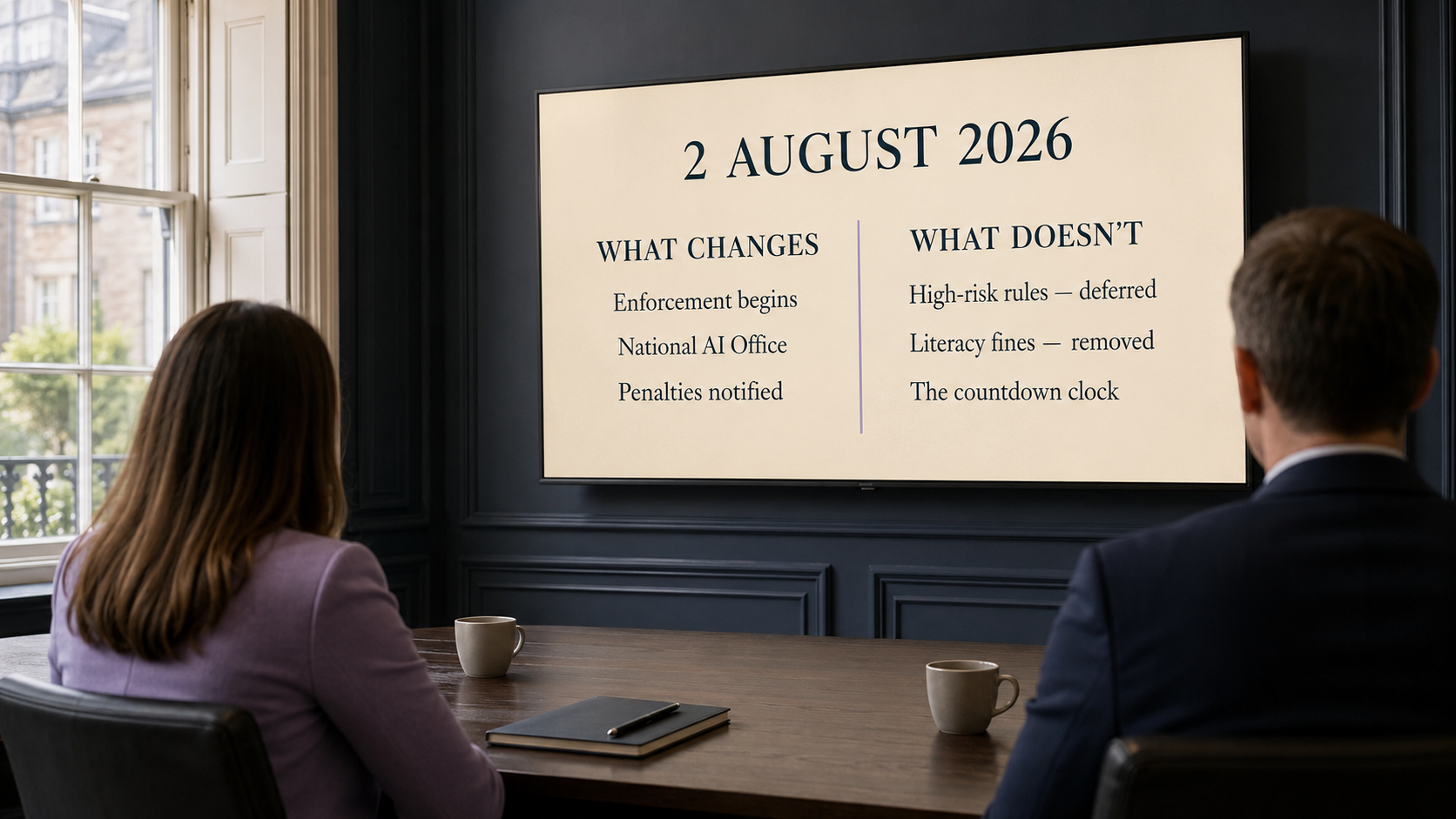
The date is real and it matters. On 2 August 2026, the EU AI Act's enforcement architecture comes into effect. In Ireland, the National AI Office stands up to coordinate enforcement, and thirteen sectoral regulators (across banking, health, data protection and other domains) take on new supervisory powers over AI use in the organisations they already oversee. The penalty framework is notified to Brussels the same week: up to €15 million or 3% of global turnover for general non-compliance, €35 million or 7% for prohibited uses. Obligations for general-purpose AI models also apply from this date.
In short: the referee walks onto the pitch. That is genuinely significant, and any organisation that has treated the AI Act as theoretical will find it stops being theoretical this summer.
What doesn't happen on 2 August
Three things widely reported as landing this August are not landing this August, and the record is worth stating carefully, because we've had to correct our own coverage as the legislation moved.
The high-risk rules don't land. Through the Digital Omnibus, endorsed by the Parliament on 16 June and given final approval by the Council on 29 June 2026, the obligations for high-risk AI systems were deferred to December 2027 for standalone Annex III systems and August 2028 for AI embedded in regulated products. If your reading of the Act dates from early 2026, this is the single biggest change.
The literacy hammer doesn't fall. Article 4, the AI literacy obligation, has been law since February 2025, but the Omnibus softened it from an obligation to ensure a sufficient level of AI literacy to an obligation to support its development. An obligation of effort, not of result, with the hard penalty pressure removed. The pre-Omnibus version is still circulating in vendor decks and conference slides as if nothing happened.
The deadline panic isn't the reason to act. This is the correction that matters most. A market of training providers spent the first half of 2026 selling AI literacy courses against a countdown clock. The clock has now been quietly dismantled, and much of the content sold against it is already out of date. Any training pitch that still leads with "the deadline" is telling you something about how carefully its authors track the legislation they teach.
What survives every amendment
Strip away the deferred provisions and the softened wording, and what remains is the part that was never really about the AI Act at all.
Your people are using AI now: Copilot, ChatGPT, the embedded features in the CRM and the LMS and fifty other tools that added AI in the last eighteen months. When something that carries your organisation's name turns out to be fluently, plausibly wrong, the fabricated citation, the invented figure, the confident misstatement of a rule, the question that gets asked isn't "which article of the AI Act applied?" It's the older, simpler, harder one: what measures did you take?
Courts and tribunals worldwide have now ruled on more than 1,200 incidents of professionals submitting unverified AI-generated content. "The tool did it" has not worked as a defence once. That exposure existed before the AI Act, exists under it in its softened form, and will exist after the next amendment. Regulation moves; professional accountability doesn't.
Regulation moves; professional accountability doesn't. The right training question was never "what does the deadline require?"
Which is why the right training question was never "what does the deadline require?" It was always: what do the duties my people already carry require of them, now that AI does the first draft?
What we've built on that ground
This is the thinking behind something we're launching next month, and this piece is its announcement.
AI for Professional Practice is a modular CPD programme for regulated professionals, solicitors, accountants, insurance and financial services professionals, company directors. Module 1 is free and open now. It is deliberately not a course about AI. It's about the duties professionals already carry (accountability, verification, confidentiality, judgement) and what AI changes about discharging them.
Two design decisions follow directly from everything above. First, it's built to be deadline-independent: nothing in it needs rewriting when the next omnibus lands, because it stands on professional accountability rather than regulatory countdown. Second, every module carries a visible verification stamp (last verified accurate, next review due) and is re-verified quarterly, because a course that warns about unverified content had better be able to show its own working.
One more thing. The programme's landing page opens with a ten-second test: two sentences from the same AI-drafted client letter, one quoting a real authority, one citing a case that does not exist. Most people hesitate. Some pick wrong. Take it before you start Module 1, and you'll know in ten seconds whether this programme is for you or for your members.
One real sentence. One fabricated authority. Ten seconds.
Take the ten-second test →And for professional bodies, training providers and corporate academies: the programme is built to be licensed, branded as yours, on your own LMS, re-verified quarterly so it never quietly goes stale. Early conversations shape the licensing round; the landing page has the details.
Reviewing what your organisation's own programmes need before August? The Programme Design Diagnostic is a fixed-fee, independent read on a single programme: a board-ready diagnosis and a costed build scope, in two to three weeks. If the answer turns out to be a build, our custom eLearning development page sets out how that work runs.
For the full background on the literacy obligation itself, the companion piece is the AI Act deadline most organisations are not ready for, updated as the legislation moved. See more insights from LearnFrame.