In the first two parts of this series we looked at what is usually hiding under "we need to do AI" — an offering that was never rebuilt for the buyer it now has, and a team that can deliver anything but owns no direction.
This part, like the others, is written for one specific room: EdTech businesses, professional certification and membership bodies, and content-rich organisations between roughly €1M and €10M. If you run one of those, the decision below is one you have had, or are about to have. If you don't, it won't apply — and that is deliberate, because the whole argument turns on the particular way these organisations decide what to build, launch or accredit next.
For the people who do run them, it is the decision they most want a clean answer to, and the one where wanting a clean answer is itself the trap.
The sentence this time is not a crisis or a frustration. It is a deadlock:
""We can't agree on what to build next. Everyone has a different answer.""
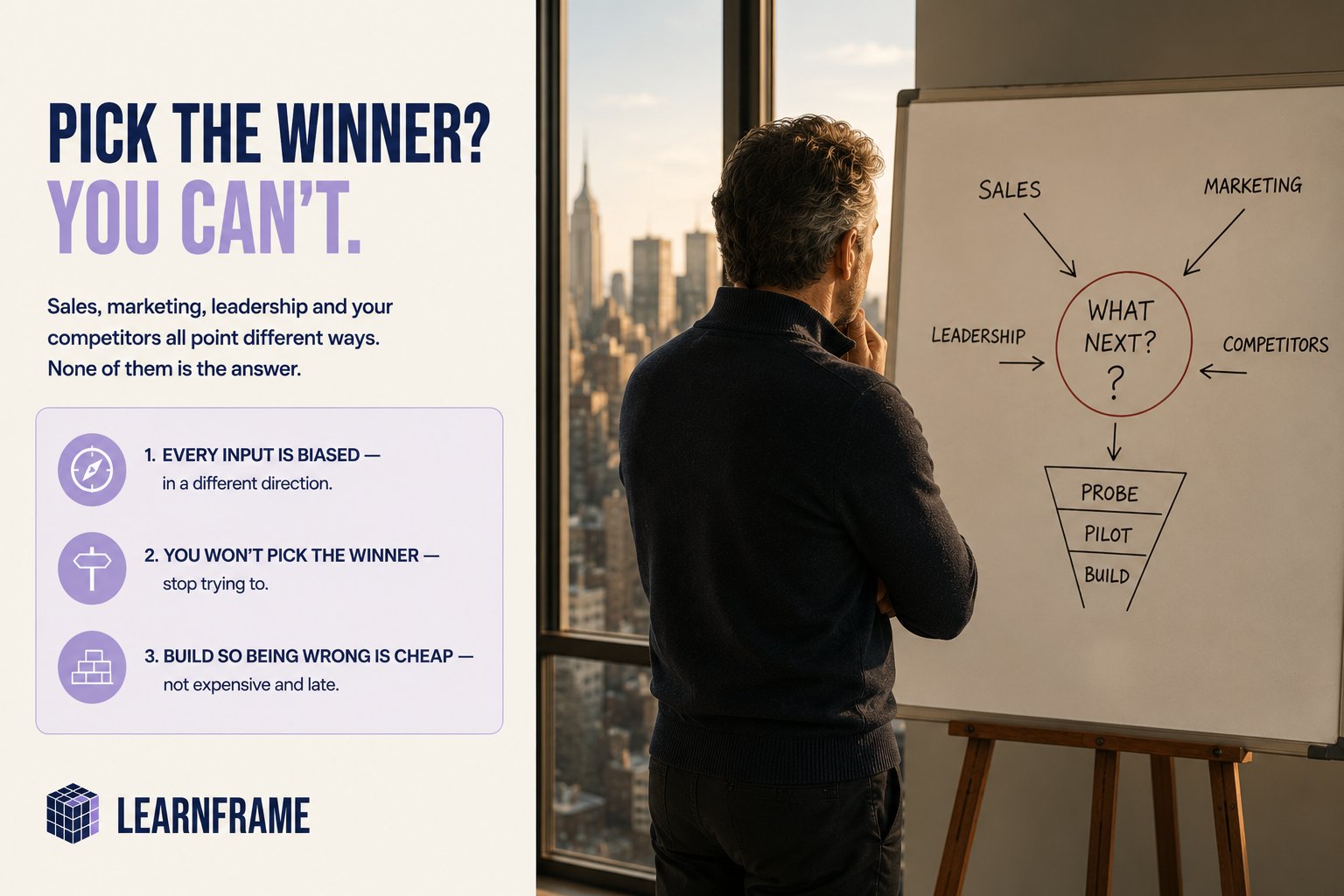
Sales has one. Marketing has another. The leadership team has a third. The competitor set seems to suggest a fourth. Each is argued in good faith, each has evidence behind it, and none of them settles it. So the decision stalls, or the loudest voice wins, and either way a year of build — a new product, a new programme, a new qualification — gets bet on a call nobody could honestly stand behind.
Here is the reframe, and it should come as a relief rather than a verdict: the goal was never to make this decision correctly. It can't be made correctly — not because you aren't good enough, but because the inputs will not allow it. The organisations that succeed at this are not better at predicting. They are better at deciding in a way that survives being wrong.
Why the decision is genuinely hard — and why every input is biased
It is worth being precise about why the disagreement happens, because the disagreement is not dysfunction. It is structural.
Sales is reporting what the loudest accounts want — the most vocal customers, the members who email the chief executive, the biggest training buyer who always picks up the phone. The loudest are rarely the highest-volume or the most representative; they are simply the most audible, and often the most marginal. The members renewing quietly and the learners drifting away without complaint are the signal that actually matters, and they are the ones not in the room.
Marketing is reading search demand, keyword patterns and a handful of feedback conversations. Directionally interesting, statistically thin, and dangerously easy to over-fit into a story that feels validated because the words came back the way you hoped.
The leadership instinct is to do more of the thing that worked — run the flagship qualification again, extend the programme that sold, produce more of the catalogue that built the name — at precisely the moment the numbers say its pull is fading. This is the most dangerous of the four, because it arrives dressed as experience rather than as a guess, and experience is hard to argue with in a room.
And "do what the others in the sector are doing" feels like evidence when it is mostly synchronised guessing — a set of organisations adding the same credential, shipping the same feature, chasing the same trending topic, each watching the others and mistaking the movement for direction.
Four inputs. All genuine. All distorted in different directions. None decisive. Almost nobody writes this honestly because it has no tidy resolution — and the absence of a tidy resolution is the actual finding.
The mistake is trying to get it right
Look at how industries that live or die by this decision behave. A film studio greenlighting a slate does not believe it can pick the one title that pays for the rest. A venture fund backing a portfolio does not believe it can identify the winner in advance. Their skill is not prediction. It is constructing a position where being wrong most of the time is survivable and being right occasionally is transformative.
The failure mode in an organisation between €1M and €10M is the exact inverse. It treats "what do we build, launch or accredit next" as a single high-stakes call to be made correctly, goes all-in on the most persuasive signal, and has no structure that survives the call being wrong, which most of the time it will be. The studio has made peace with being wrong four times out of five. The mid-market EdTech business, certification or membership body, or content-rich organisation bets the roadmap as if wrong were not an option, and is then blindsided by the cost when it was.
So the question is not "how do we make this call more accurately." It is "how do we decide in a way that does not require us to be right."
What the discipline actually is
The answer is not a bigger research budget or a sharper framework. It is a sequence of escalating probes, where each stage costs the audience more, and only a signal you can trust unlocks the next spend.
The principle that governs the whole thing: the validity of a test is set by how much it costs the respondent, not how much it costs you to run. A free resource handed over for a completed form costs the respondent almost nothing — so it tells you almost nothing, and worse, it tells you so confidently. A webinar is not a small course or a short programme; it is a demand probe — who registers, who stays to the end, who asks a question, who asks what comes next. A landing page for something that does not exist yet, with a real action behind it, tests intent at near-zero build cost. A small paid commitment — a paid pilot cohort, a paid preview module — is worth more than a thousand free sign-ups, because money is the only questionnaire that does not lie.
This is the studio's gate logic made operational. The studio does not greenlight the expensive film. It greenlights the script, then the cast read, then the test screening — each gate costs more, and each one is allowed to kill the project. The discipline is not "build small then build big." It is: never commission the expensive thing — the full product, the new programme, the new credential — until a signal that genuinely cost someone something has fired. That is the structure that survives being wrong, because it makes being wrong cheap and early instead of expensive and late.
Why we will tell you all of this and still say you need help
We have just given you the method. We will be honest about why that is safe to do.
A method is not the judgement to run it. These principles tell you what to do when things go to plan. They cannot tell you which of four conflicting, biased signals to trust at the moment they disagree and the guidelines do not break the tie — and they always disagree, and the guidelines never break the tie. That gap is not a flaw in the method. It is the irreducible part, and it is the part experience exists for.
And there is a reason this was hard to see from the inside, and it is not a lack of intelligence. It is proximity. The same closeness that makes a leader the right person to run the organisation makes them the wrong person to see it clearly — too attached to the original vision, too invested in what used to work, hearing the loudest voices too personally. You cannot read the label from inside the jar. An outside view is not valuable because it is cleverer. It is valuable because it is outside — structurally unattached to the things distorting the inputs.
That is also why this work is built the way it is. The old model of expertise was "if I know more than you, my job is safe." This one is the opposite: fix the problem, install the discipline, leave the organisation better placed for its full-time solution — and go. A practice whose model only works by making itself unnecessary can afford to give the method away on the way in, because the method was never the thing being sold. The judgement to run it under real, conflicting pressure, and the integrity to leave once it is running, was.
It begins, as all our engagements do, with a paid four-to-six-week diagnostic that establishes — independently and unsentimentally — whether this is even the right problem to be solving.
The last significant thing you built, launched or accredited: was it chosen because a signal you trusted fired — or because the argument in the room was loudest?
Where the practice comes in
LearnFrame begins every engagement with a paid four-to-six-week diagnostic phase — an independent, ground-truth view of what is actually causing the problem, across product, people, market and capital, with a clear path into whichever of the two engagement modes best fits what surfaces.
Our briefings and diagnostic tools are on the resources page, free and ungated. If you would like to talk through what a diagnostic engagement could look like in your organisation, we would welcome the conversation.