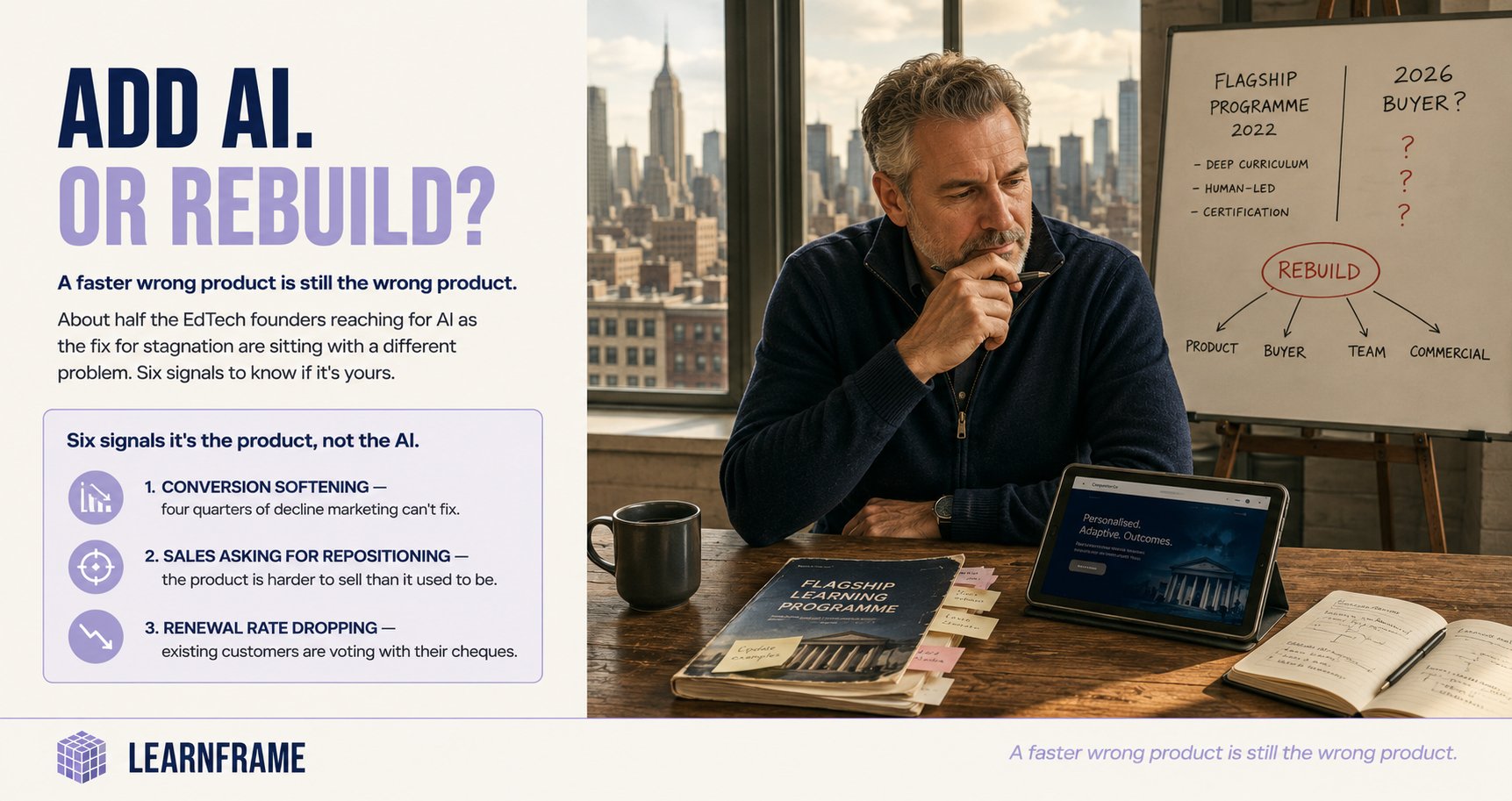
A certification body whose flagship qualification has not been refreshed since 2022. A training company whose flagship cohort runs essentially the same content it ran in 2021. A membership institute whose CPD calendar is structurally the same as it was before the pandemic. A content business whose library was indexed for keyword search before AI-native discovery existed.
Different sectors. Same problem. AI is not going to fix any of it.
We wrote three weeks ago about why "we need to do AI" is rarely the right diagnosis when an EdTech founder tells us the company has stagnated. About half the time, the real problem is the one above: the product has not been refreshed in years, the buyer has moved, and nobody has wanted to say so out loud. This is by some distance the most common pattern we see in EdTech businesses between €1M and €10M of revenue. It is also the one founders most often miss when looking from inside.
Why this is the most common pattern
The product was right when it was built. That is what makes it so hard to see when it is no longer right.
Founders remember what good looked like when they shipped the first version, and they extrapolate forward from that memory. The buyer, meanwhile, has been quietly evolving. Different expectations of pacing. Different reference points for what "modern" looks like. Different ideas about what they will pay for and what they expect to come bundled.
None of this arrives as a single obvious signal. It arrives as a slow softening of conversion, a slow climb in churn, a slow shift in who is being beaten on deals. By the time the trend is visible in the numbers, it is usually two years old. By the time the founder accepts what the trend means, it is two and a half. And then, almost always, the response that gets reached for first is not "rebuild the product" — it is "add AI to it." Which is where the trouble starts.
Why founders reach for AI instead
AI feels like motion. A product rebuild feels like admission.
AI gets external validation — boards approve it, investors ask about it, the trade press writes about it. A rebuild gets internal resistance — every senior person whose work is bound up with the existing product has reason to defend it. AI is faster to start. (It is slower to results, but the start-versus-results distinction is not visible until twelve months in.) And the founder's identity is woven through the existing product in a way it is not yet woven through whatever the rebuild would produce. Reaching for AI is, at a quite human level, easier than reaching for a redesign.
None of this is a criticism of the founders we sit with. It is a description of why an otherwise capable team ends up spending the better part of a year on AI investment that bolts onto a product the market is already moving away from. The pattern is structural, and the urgency around AI is making it worse, not better.
How to know if this is your problem
Six signals, in rough order of how often we see them.
One. Conversion on the flagship has softened over four consecutive quarters. Marketing has been told it is a marketing problem. It is not. The flagship is no longer landing the way it used to land.
Two. The sales team is asking for "better positioning" — shorthand for "this product is harder to sell than it used to be." Better positioning of an aging product produces, at best, a temporary lift. The underlying drag returns within a quarter.
Three. Your renewal rate is declining. The existing customers — the ones who know the product best — are voting with their cheques on whether it still fits.
Four. Newer entrants are doing approximately what you do, but in 2026 clothes. Different format, different cadence, different price shape, different bundle. They are not necessarily better. They are more current. That is enough.
Five. Your product manager keeps proposing AI features rather than a product redesign. The team has read the room. They know the founder is reaching for AI, and they are proposing what they think will get approved, not what they think will fix the problem.
Six. You have not sat with a buyer of the product — a genuine, currently-deciding-between-options buyer — in the last twelve months. Not a customer success call. Not a renewal review. A real conversation with someone choosing between your product and someone else's.
If three or more of these are true, the problem is unlikely to be solved by AI.
What AI bolted onto the wrong product actually produces
It produces a faster version of the wrong product. The platform loads quicker; the search returns smarter results; the chat interface answers natural-language questions; the content is recommended more accurately. None of that fixes the underlying issue, which is that the product the AI is making faster is no longer the product the buyer is buying.
We have seen this exact mistake play out in real time across several EdTech businesses over the last eighteen months. AI gets bolted on; the demo improves; the deck looks sharper; investor confidence ticks up. The metrics do not move. Twelve months later the founders are back at the same conversation they were in before, having spent a year and a meaningful share of cash on the wrong investment.
The move
Pause the AI work. Not cancel — pause.
Before the next significant AI investment commits, run a structured diagnostic across four dimensions: the product itself, the buyer and the buying decision, the team and how it ships, and the commercial picture underneath. The diagnostic should be honest and uncomfortable. The output is a clear picture of what the next version of the product needs to become — not what AI features should be added.
Once that picture is clear, AI almost always plays a role in the rebuild. It is rarely the centrepiece, and it is never the whole answer. It is one tool inside a larger redesign, and the redesign is what makes the AI investment worth doing.
The companies that move first on AI without doing this work do not get ahead. They build a faster wrong product and spend the next year explaining to the board why the metrics did not move. The companies that pause for four to six weeks before committing end up with a clear picture of what is actually broken, what AI can fix, what AI cannot, and where the real investment should go.
Where we come in
At LearnFrame we run this diagnostic for EdTech businesses in the €1M–€10M range, as a paid four-to-six-week engagement with a mutual exit at the end. We do not start with a recommendation. We start with the buyer the new product is meant to win — not with the product the team has already built — and we let everything else follow from there.
The free assets that begin the same work — the Programme Design Audit and the Board Briefing — are on the resources page. They will take you part of the way. If you want the diagnostic done properly, with senior practitioners, in four to six weeks, a thirty-minute conversation is the right next step.
The harder question is the one to ask yourself first: what would it take to admit, this week, that the AI question might not be the right question — and that the rebuild you have been avoiding is the work that actually moves the company?