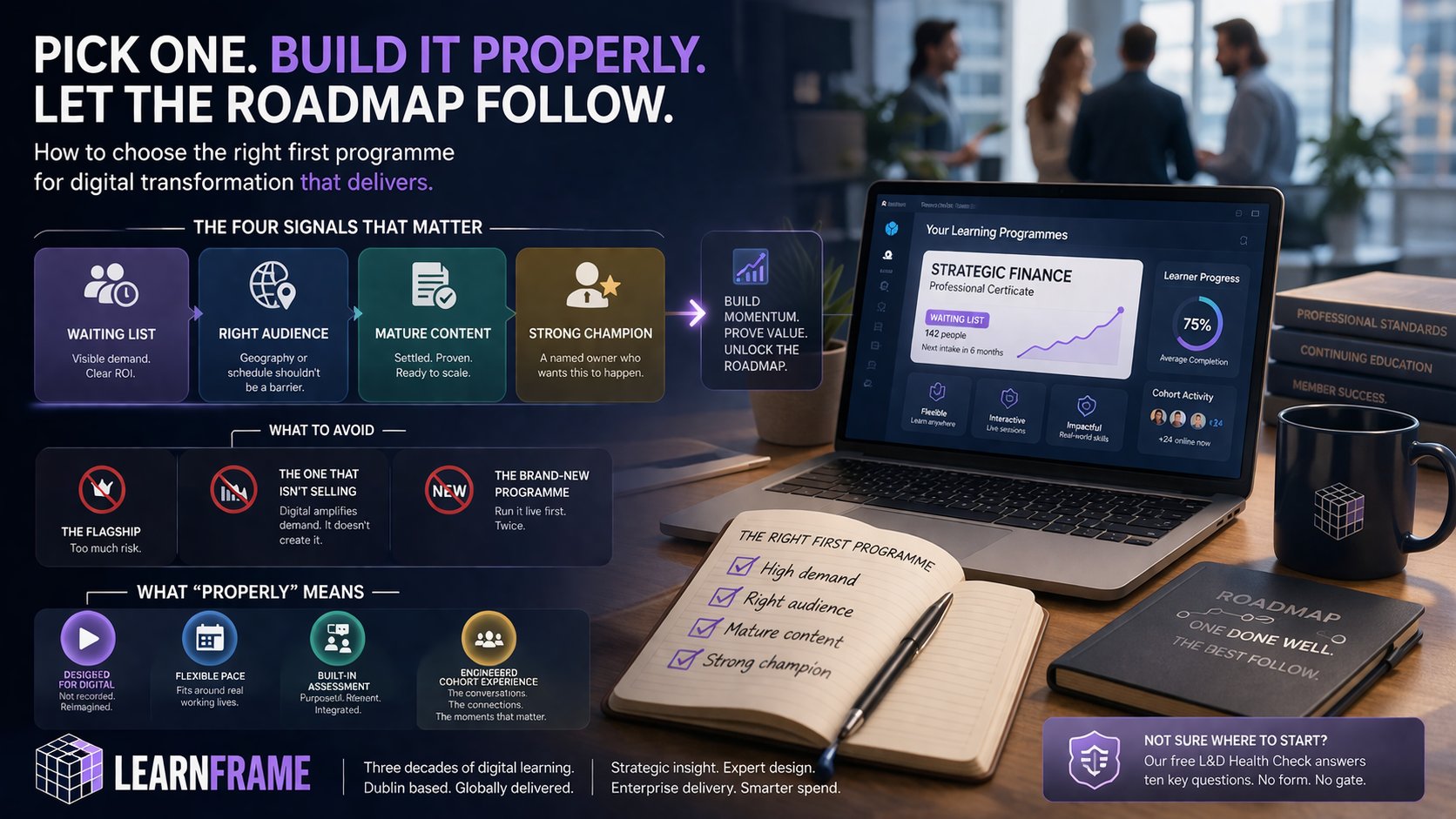
Across the professional institutes and membership bodies we work with in Ireland and the UK, there is a consistent pattern in the ones that get digital transformation right. They don't try to do everything at once. They pick one programme, the one with the longest waiting list and the most frustrated members, rebuild it properly, and let the rest of the roadmap follow from there.
That principle is straightforward enough. The harder question, and the one that determines whether a digitisation effort succeeds or stalls, is this: how do you actually pick which programme to start with?
It is a more important question than it sounds. Most institutes that decide to start with "just one" still pick the wrong one. They go for the easiest, the cheapest, the least politically sensitive, and twelve months later they have a workmanlike digital version of a programme nobody was particularly excited about, and no clear case for doing the next one.
Here is what we have learned about choosing the right first programme.
The four signals that matter
When we work with an institute on this decision, we are looking for four specific signals. A programme that has all four is almost always the right place to start. A programme that has only one or two probably isn't.
Signal one: a waiting list, or a recurring sell-out. Not a programme that "should" be popular. A programme where members are visibly frustrated that they cannot access it. Waiting lists are the cleanest signal of unmet demand inside an institute, and they are also the cleanest signal of ROI once the digital version is live. If your first programme converts a six-month waiting list into immediate enrolment, you have your business case for the next three programmes already written.
Signal two: an audience constrained by geography or schedule. The classroom format isn't just inconvenient for these members: it actively excludes them. Practitioners outside Dublin or London. Members whose jobs make a two-day off-site impossible. International members who are technically eligible but practically locked out. When the digital version unlocks an audience that the classroom version was never going to reach, the upside is structural, not marginal.
Signal three: stable, mature content. This is the one institutes most often get wrong. They reach for the newest, most exciting programme, the one the board is most enthusiastic about, and run straight into a problem: the content is still being shaped, the curriculum is being argued about, and every digital design decision triggers another round of internal debate. Pick a programme where the content is settled. The faculty agrees on what it teaches. The structure has been refined over multiple cohorts. The digital build is then about expression, not negotiation.
Signal four: a clear, named programme owner who wants this to happen. This matters more than any of the technical considerations. Digitising a programme inside an institute is an organisational change project, not a content project. If the person responsible for the programme is sceptical, defensive, or absent, the project will stall regardless of how good the design work is. The right first programme has a champion, someone who has been frustrated by the limitations of the classroom version and genuinely wants the digital one to work.
What to deliberately avoid
There are three categories of programme that institutes are repeatedly drawn to as their "first one", and that are almost always the wrong choice.
The flagship. The crown jewel programme. The one with the most institutional pride attached. The one everyone agrees is "what the institute is known for." It is exactly the wrong place to start, because the political stakes are so high that every design decision becomes a referendum on the institute's identity. Build confidence and capability somewhere lower-risk first, then come back to the flagship when the team has the muscle memory to do it justice.
The one that isn't selling. Counterintuitively, this is also a poor first choice. If a programme is struggling in its classroom form, the digital version will struggle too, and worse, the failure will be blamed on the digital format rather than on the underlying demand problem. Digital transformation amplifies what is already there. It does not rescue what is not.
The brand-new programme. Building a digital version of something that has never run is a research project disguised as a development project. You need real cohort feedback, real instructor experience, and real iteration before you commit a programme to the more permanent digital format. New programmes should run in classroom form at least twice before being considered for digital build.
What "properly" actually means
The case for rebuilding the right first programme properly deserves unpacking, because that word does a lot of work.
Properly does not mean a recording of the classroom session uploaded to a platform. It does not mean a PDF and a multiple-choice quiz. It does not mean a webinar series. These are the formats institutes default to when they are trying to get something live cheaply, and they are precisely the formats that have given digital learning its reputation for being a poor cousin to the classroom.
Properly means the programme has been redesigned for the medium. The pacing reflects how members will actually consume it, in the gaps in their working week, not in two-day blocks. The assessment is built for digital, not bolted on. The cohort experience, the conversations, the peer learning, the moments of recognition that classroom programmes get for free, has been deliberately engineered into the online version, because it doesn't happen by accident.
This is the work that separates the institutes whose members rave about the digital version from the ones whose members ask when the classroom version is coming back.
The decision is simpler than it looks
If you are a CEO, a director of education, or a head of learning at a professional institute reading this, the practical answer is usually closer than you think.
Sit with your team for an hour. Write down the programmes that have a waiting list or routinely sell out. Cross off the flagship. Cross off anything launched in the last eighteen months. Cross off anything where the content is still being argued about. Look at what's left, and ask which of those programmes has a champion who wants this to happen.
Most institutes find that the answer is one or two programmes. Not the most prestigious. Not the most exciting. But the ones where the demand is real, the content is ready, and someone internal is leaning in.
That is your first programme. Build it properly, and the rest of the roadmap will write itself.
Where we come in
At LearnFrame, we work with professional institutes and membership bodies on exactly this kind of decision, and on the custom eLearning development work that follows. We bring three decades of digital learning experience, a strategic team in Dublin, and a development capability that delivers enterprise-quality work, with editorial discipline held to a UK or Irish agency standard, a capability we have built deliberately.
If your institute is somewhere on this curve and you would value an experienced second opinion on which programme to start with, we would welcome a conversation.
Weighing a decision like this on one of your own programmes? The Programme Design Diagnostic is a fixed-fee, independent read on a single programme, a board-ready diagnosis and a costed build scope, in two to three weeks.