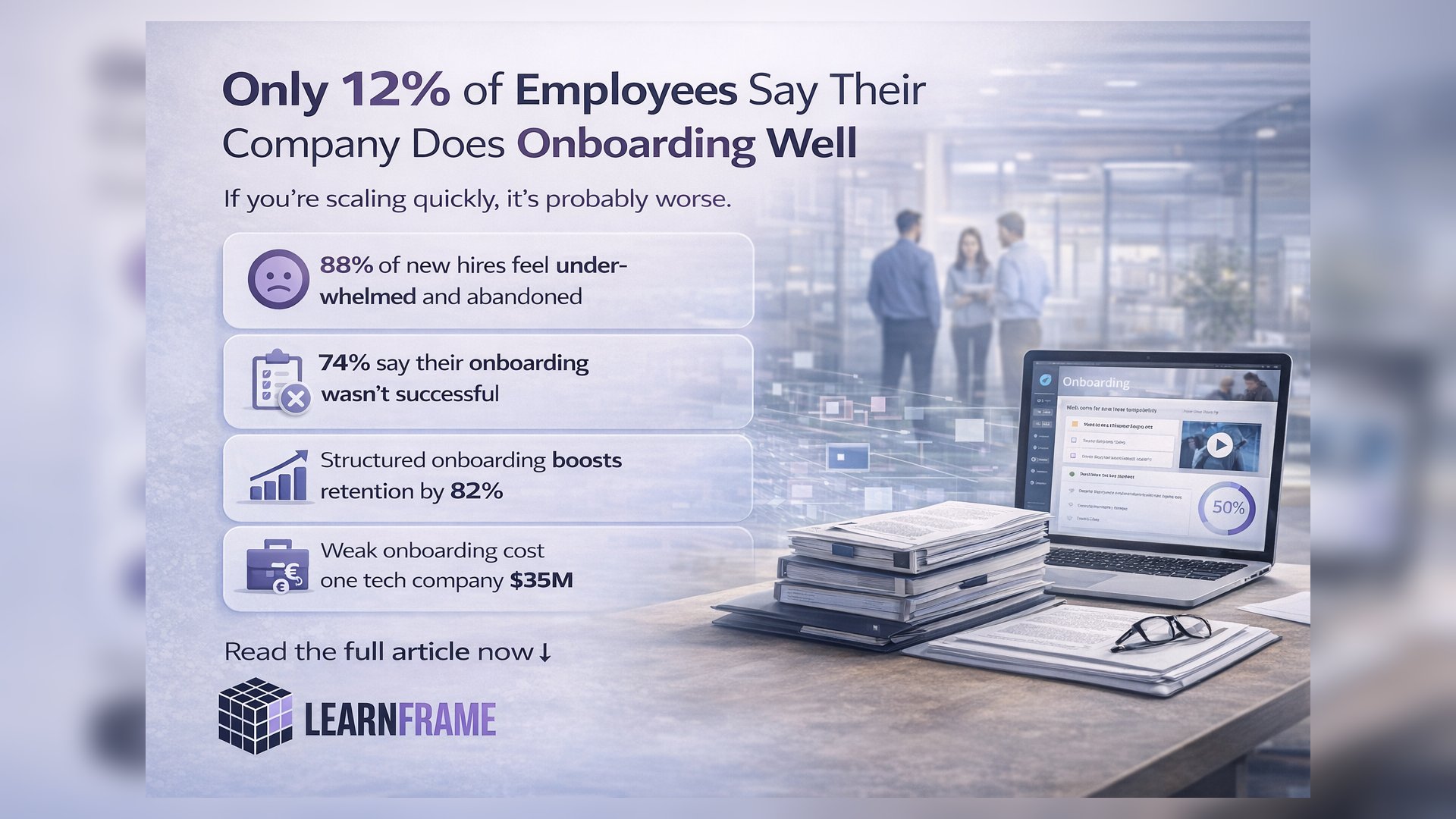
There's a number from Gallup that should stop every founder and HR leader in their tracks. Only 12% of employees strongly agree that their company does a great job of onboarding. That means 88% of new hires walk into their first weeks feeling somewhere between underwhelmed and abandoned.
And the data gets worse from there: 74% of employees say their onboarding was not successful. 52% of onboarding programmes end within the first month. 14% end within a single week.
For companies that are growing steadily, these numbers are concerning. For companies that are scaling fast, doubling headcount, opening new offices, hiring across multiple roles simultaneously, they're a crisis in waiting.
The scaling trap
Here's a pattern we see repeatedly at LearnFrame, particularly among Irish and UK technology companies in their growth phase.
A company raises funding. Growth accelerates. Hiring ramps up, ten new people a month, then twenty, then more. The product is strong, the market is there, the team is excited. Everything is moving in the right direction.
Except for one thing. The way people are brought into the business hasn't changed since the company had fifteen employees.
Onboarding is still a patchwork. A welcome email. A shared Google Drive folder with last year's slides. A few shadowing sessions with whoever happens to be available. Maybe a Notion page that's six months out of date. The founder does a culture talk when they can, but they're in back-to-back meetings most days now.
It works, sort of, when you're hiring three people a quarter. It falls apart completely at twenty a month.
The result is predictable. New hires take longer to become productive. Managers spend hours repeating the same information to every new starter. Consistency disappears, one team gets a thorough induction, another gets a laptop and a good luck. The people you've spent months recruiting and significant money hiring start to disengage before they've fully arrived.
The research backs this up. Companies with structured onboarding see 82% higher retention and up to 70% higher productivity. A weak five-day onboarding programme was linked to $35 million in productivity losses at one well-known technology company. New hires whose managers are actively engaged in their onboarding are 3.4 times more likely to describe the experience as successful, but nearly 29% of managers provide zero guidance to their new starters.
It's not that nobody cares. It's that nobody owns it.
This is the distinction that matters. In most scaling companies, the problem isn't indifference. It's capacity.
HR is stretched thin, often a single People Operations hire trying to cover recruitment, contracts, payroll, and employee relations simultaneously. They know onboarding needs work. They simply don't have the bandwidth to build a structured programme, create the content, design the learning, and maintain it as the company evolves.
Managers care, but they're under pressure to deliver results, not design training. They handle onboarding the way they learned it, which usually means improvising based on what they remember from their own first week.
And there's no L&D function. No one whose job it is to think about how people learn in this organisation. No one asking: what does a new hire in this role actually need to know in their first week? Their first month? Their first quarter? What's the most effective way to deliver that? And how do we know it's working?
For companies between 50 and 200 employees, this is almost universal. Too big for ad-hoc. Too small for a dedicated learning team. It's a gap that gets wider with every new hire.
The cost of waiting
The temptation is to treat onboarding as something you'll fix later, once the current hiring wave settles, once you've closed the funding round, once you've hired an HR Director who can take it on.
But the cost of waiting is compounding. Every month of poor onboarding means slower ramp-up times, higher early attrition, inconsistent knowledge transfer, and a growing gap between the people who've been there since the beginning and the people who joined last quarter.
New hires decide in the first month whether the job is a good fit. 37.9% of employees leave within the first year. And replacing them costs between 50% and 200% of their annual salary.
For a company hiring 50 people a year at an average salary of €60,000, even modest early attrition driven by poor onboarding represents hundreds of thousands in wasted investment, not including the lost productivity, the management time, and the cultural disruption of constant turnover.
What good onboarding actually requires
Fixing onboarding isn't about finding a clever app or buying an off-the-shelf course. It's about designing a structured learning experience, one that's role-specific, consistent, and built around how adults actually retain and apply information.
That means a clearly defined onboarding journey with milestones at day one, week one, month one, and beyond, not a single afternoon of introductions. It means content that's designed once and delivered consistently to every new hire, regardless of who their manager is or which team they're joining. It means building in assessment, not a quiz for the sake of it, but genuine checkpoints that confirm a new hire is ready for each stage.
And it means treating onboarding as a digital learning challenge. Because in a hybrid, multi-location, fast-growing environment, the only way to deliver consistent, high-quality onboarding at scale is to design it as a structured digital programme with human touchpoints built in at the right moments.
This is instructional design. It's a discipline. And it's the piece that most scaling companies are missing, not because they don't value it, but because they don't have it in-house.
How LearnFrame helps
At LearnFrame, we design and build onboarding programmes for companies in exactly this position, growing fast, hiring across multiple roles and locations, and aware that their current approach isn't sustainable.
We work with the company to understand the roles, the knowledge requirements, and the culture. We design the onboarding journey. We build the digital content, structured, engaging, role-specific. We implement it on the platform the company already uses or help them select one. And we hand back a programme that runs consistently without requiring a full-time L&D team to maintain it.
We combine 30 years of learning design expertise with a dedicated production team that delivers enterprise-quality content at accessible prices, typically significantly less than comparable UK or Irish agencies. That's not a compromise on quality. It's a structural advantage we've built deliberately.
For companies that need strategic guidance alongside the build, someone to think about the broader learning and development picture, not just the onboarding programme: Paul Robinson, our founder, also works as a fractional L&D executive with scaling businesses. It's a model that gives you strategic leadership without the full-time overhead.
If your company is growing faster than your onboarding can keep up with, or if you know your current approach isn't working but don't have the internal capacity to fix it, that's exactly the conversation we're built for.
We'd rather have that conversation now than after you've lost good people to a problem that was always fixable.
Weighing a decision like this on one of your own programmes? The Programme Design Diagnostic is a fixed-fee, independent read on a single programme, a board-ready diagnosis and a costed build scope, in two to three weeks.