In the first two articles in this series, we looked at why many organisations struggle to get started with digital learning, and why design quality determines whether eLearning actually works. This week, we want to talk about something different. Not what's going wrong, but what's now possible that simply wasn't two years ago.
The research that should be on every learning leader's desk
In February, The Josh Bersin Company published the results of a major study into corporate learning, drawing on more than 50 case studies and data from 800 organisations worldwide. The findings this time are significantly different from anything that came before.
Organisations that have adopted what Bersin calls "dynamic enablement", AI-first learning that is personalised, on-demand, and embedded in the flow of work, are dramatically outperforming those still relying on traditional approaches.
The numbers are hard to ignore. These organisations are six times more likely to exceed their financial targets, five times more likely to be considered great places to work, and seven times more likely to achieve high levels of productivity. They're also twenty-eight times more likely to unlock employee potential, a metric that matters deeply in an era where 74% of senior leaders say their companies lack the skills to compete.
So what's actually changed?
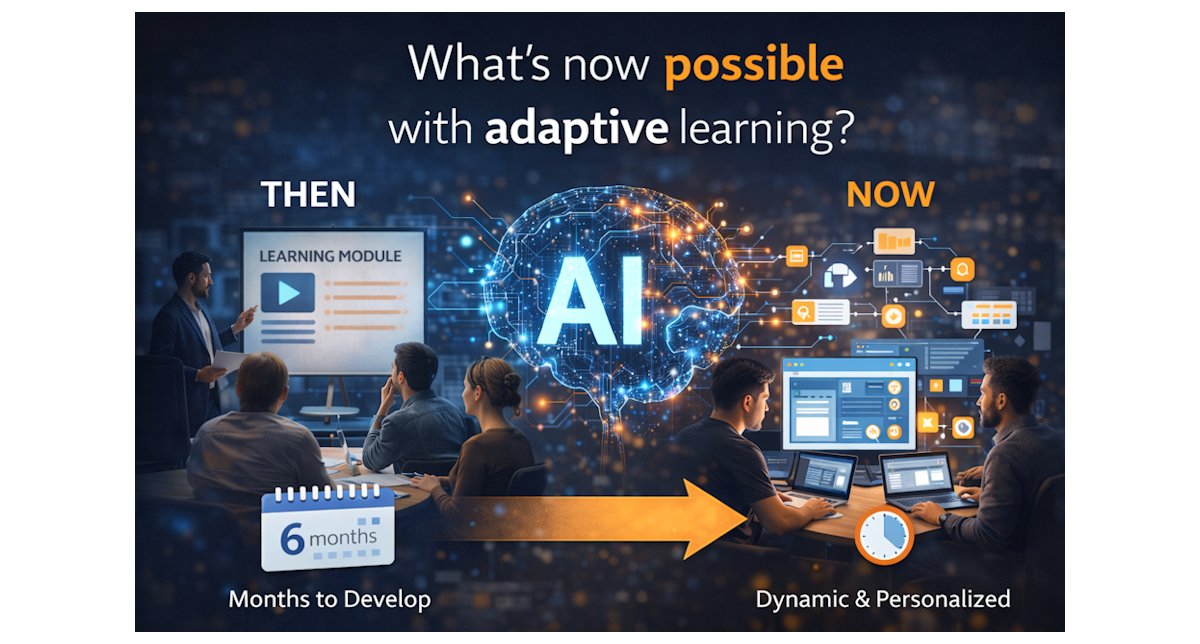
Two years ago, "adaptive learning" was a concept most organisations understood in theory but couldn't implement in practice. It required enterprise-level budgets, specialist development teams, and months of build time.
That's no longer the case. AI has compressed the timeline and lowered the barrier dramatically. Platforms can now generate and adapt learning content in days rather than months. They can analyse how individual learners interact with material and adjust the path in real time. They can surface knowledge at the point of need, inside the tools people are already using.
The Bersin research describes this as a shift from "static training", where content is built once and delivered identically to everyone, to "dynamic enablement," where learning is continuously generated, personalised, and connected to actual performance.
A compliance programme that once took six months to develop can now be built in weeks and updated as regulations change. An onboarding journey can now adapt to each new hire's role, experience level, and learning pace. A technical skills programme can deliver practice scenarios, real-time feedback, and personalised coaching at scale.
Why most organisations are still behind
Despite the opportunity, the research found that fewer than 5% of learning teams have adopted AI-native technology. Less than 10% even have a strategy for using AI in learning and development. And three quarters of organisations still treat learning as something separate from work.
The pace of change has been disorienting. The market is flooded with platforms making bold claims. Many organisations have existing investments they're reluctant to abandon. And the internal expertise to evaluate and implement new approaches often doesn't exist.
The result is a widening gap. A small number of organisations are moving quickly and seeing transformational results. The majority are aware that something has changed but aren't sure what to do about it.
You don't have to start from scratch
This is important, and it's something the hype around AI in learning often misses. Adopting a more modern approach doesn't mean throwing away everything you've already built. It doesn't require an enterprise budget or a team of AI specialists. And it doesn't have to happen all at once.
For most organisations, the practical path looks something like this: start by understanding where you are now. Then identify one programme, one audience, or one business problem where a more adaptive approach would have the most impact. Pilot it. Prove the model. Measure the outcomes. From there, scale what works.
This phased, pragmatic approach is how the majority of successful transformations actually happen. Not a big bang. A series of deliberate steps.
Where LearnFrame fits
At LearnFrame, this is the conversation we've been having with organisations for over 30 years, long before AI entered the picture. It is the conversation behind every custom eLearning development engagement we take on.
The technology has changed enormously. The core question hasn't: how do you turn what your organisation knows into learning that actually helps people perform?
We help organisations understand what's now possible, assess where they are today, and build a practical plan to get from one to the other, leveraging what they already have, not replacing it.
If you've read the Bersin research and found yourself thinking "this sounds right, but where do we actually start?", that's exactly the question we help answer.
Weighing a decision like this on one of your own programmes? The Programme Design Diagnostic is a fixed-fee, independent read on a single programme, a board-ready diagnosis and a costed build scope, in two to three weeks.