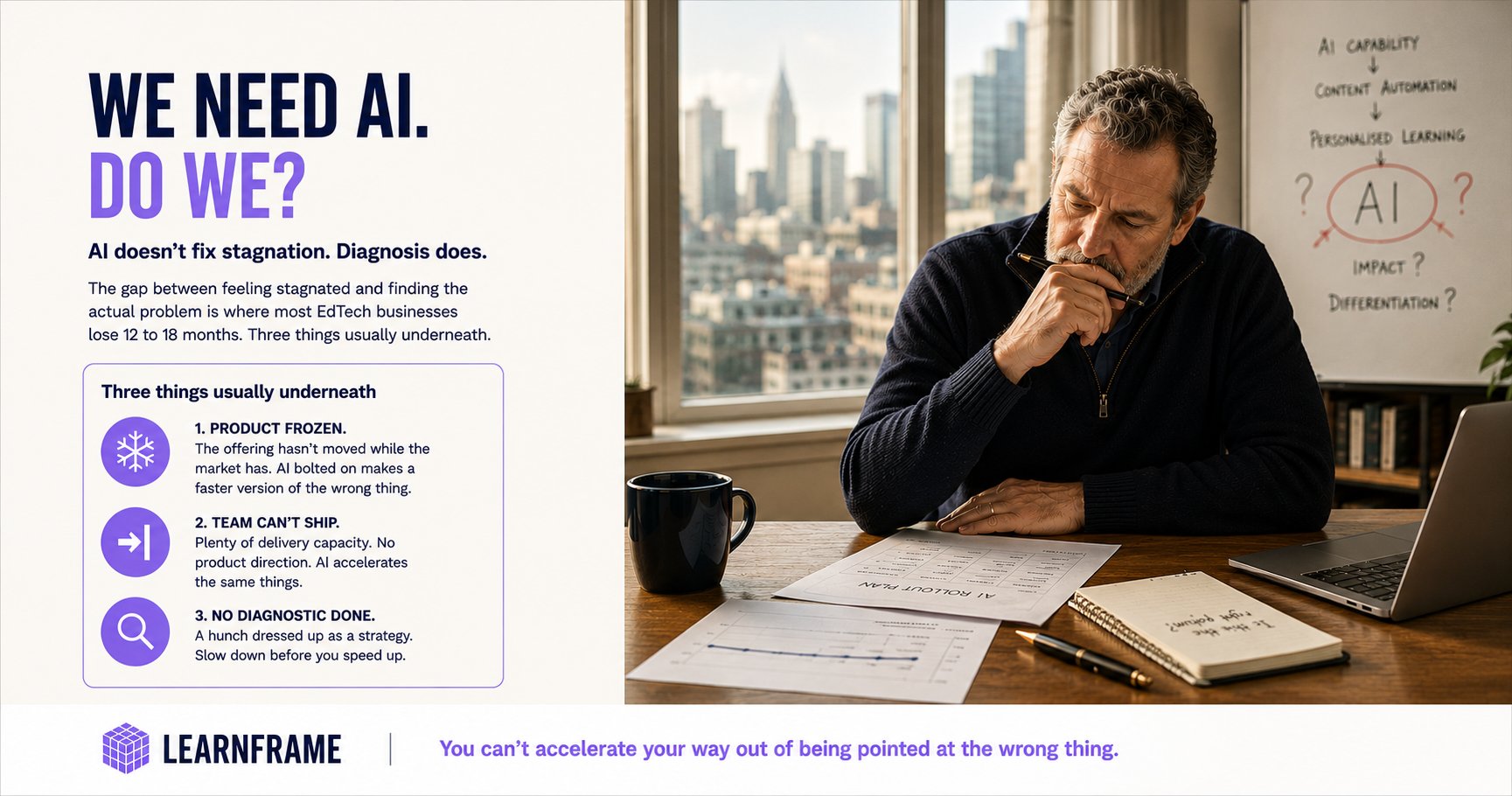
In a very high proportion of our conversations with CEOs and MDs across EdTech over the past few months, some version of the same sentence keeps coming up:
"We've stagnated. Our competitors are doing AI. We need to do the same or we'll be left behind."
It is delivered with urgency. Sometimes with frustration. Almost always with a clear instruction sitting inside it: help us do the AI thing.
It is, in our experience, almost never the right diagnosis.
That sounds counterintuitive, given how visible AI has become as a competitive force, and how genuinely useful it is when properly applied. But the sentence above is rarely about AI. It is about something underneath, that the founder has not yet named, and that the urgency around AI is making it harder rather than easier to look at. We see this consistently enough across EdTech businesses between €1M and €10M of revenue that we have started writing the pattern down.
What is actually happening, in those conversations, is one of three things. Sometimes a combination. Almost never AI by itself.
The first thing: the product hasn't been refreshed in years
In about half the cases, the company is still selling a version of its offering that is materially the same as it was three or four years ago. The market has moved. The buyer's expectations have moved. The competitive set has moved. The product has not. AI is being reached for as a proxy for a much more uncomfortable conversation, which is whether the offering itself needs to be rebuilt for what the buyer is actually buying now.
This is the most common pattern, and the hardest one for a founder to see, because the offering is usually their original vision and their identity is woven through it. Reaching for AI is genuinely easier than reaching for a redesign. The problem is that AI bolted onto the wrong product produces a slightly faster wrong product, not a right one.
The second thing: the team is structured to deliver, not to ship
In about a third of cases, the company has plenty of delivery capability and not enough product thinking. The team can build whatever is asked of them. Nobody senior is asking the right things. There is no one whose primary job is to look six months ahead, decide what the next version of the offering should be, and own that decision through to launch.
In a structure like this, AI tooling does not help. Adding AI to a team that cannot ship faster makes them ship the same things faster, which is not the same problem. The bottleneck is not capacity. It is direction. AI does not provide direction; senior product leadership does.
The third thing: nobody senior has actually run the diagnostic
In the remaining cases, the founder has reached the limits of what they can see from inside the business. They can sense that something is wrong; they cannot name what. AI is being grasped at because something needs to be done, and AI is the most visible candidate. There is, however, no diagnosis. There is a hunch, dressed up as a strategy.
This is the easiest of the three to address and the most often missed, because it requires the founder to slow down at exactly the moment they feel they should speed up.
Why AI is so rarely the answer on its own
Here is the pattern that holds across all three. AI is a tool. A useful one, in a particular set of conditions. It accelerates work that is well-structured, where the people using it understand what good output looks like, and where there is a clear commercial reason for the acceleration. It does not solve a stagnation problem because stagnation is almost never an acceleration problem.
Stagnation is a direction problem. You cannot accelerate your way out of being pointed at the wrong thing.
When we have engaged with EdTech businesses sitting on the trigger phrase above and walked them through a paid four-to-six-week diagnostic, AI ends up being part of the answer in roughly two thirds of cases. It is never the whole answer. It is usually a tool inside a much larger redesign — refreshing the product, restructuring the team, or naming what the actual commercial question is — and the redesign is what makes the AI investment worth doing.
The companies that move first on AI without doing the diagnostic do not get ahead. They build a faster version of the wrong thing. The companies that pause for six weeks before moving end up with a clear picture of what is actually broken, what AI can fix, what AI cannot, and where the real investment should go.
What to do if that sentence is on your desk right now
If you are sitting with the trigger phrase — yours or one your board has put to you — the most useful next move is not to reach for the answer. It is to slow down for long enough to name the question.
An outside team can do this for you in four to six weeks. The output is an independent ground-truth view of what is actually causing the stagnation, organised across the dimensions a serious diagnostic phase would assess — the product, the people structure, the market and buyer, and the commercial picture underneath. Some of what surfaces will be uncomfortable. Almost all of it will be more useful than another quarter of trying to AI your way out of a problem AI cannot solve.
You do not need to commission a paid engagement to start. The same structure can be self-administered, honestly, in a focused afternoon. Sit with each of the four dimensions in turn. Be unsentimental about what you find. The pattern that emerges is usually clearer than the founder feared, and more actionable.
What would it take, this week, to admit that the AI question might not be the right question?
Where LearnFrame comes in
LearnFrame begins every engagement with a paid four-to-six-week diagnostic phase. The output is an independent, ground-truth view of what is actually causing the stagnation — across product, people, market, and capital — with a clear path into whichever of the two engagement modes (consultancy-led build, or fractional embed) best fits what surfaces.
Our briefings and diagnostic tools are on the resources page, free and ungated. If you would like to talk through what a diagnostic engagement could look like in your business, we would welcome the conversation.