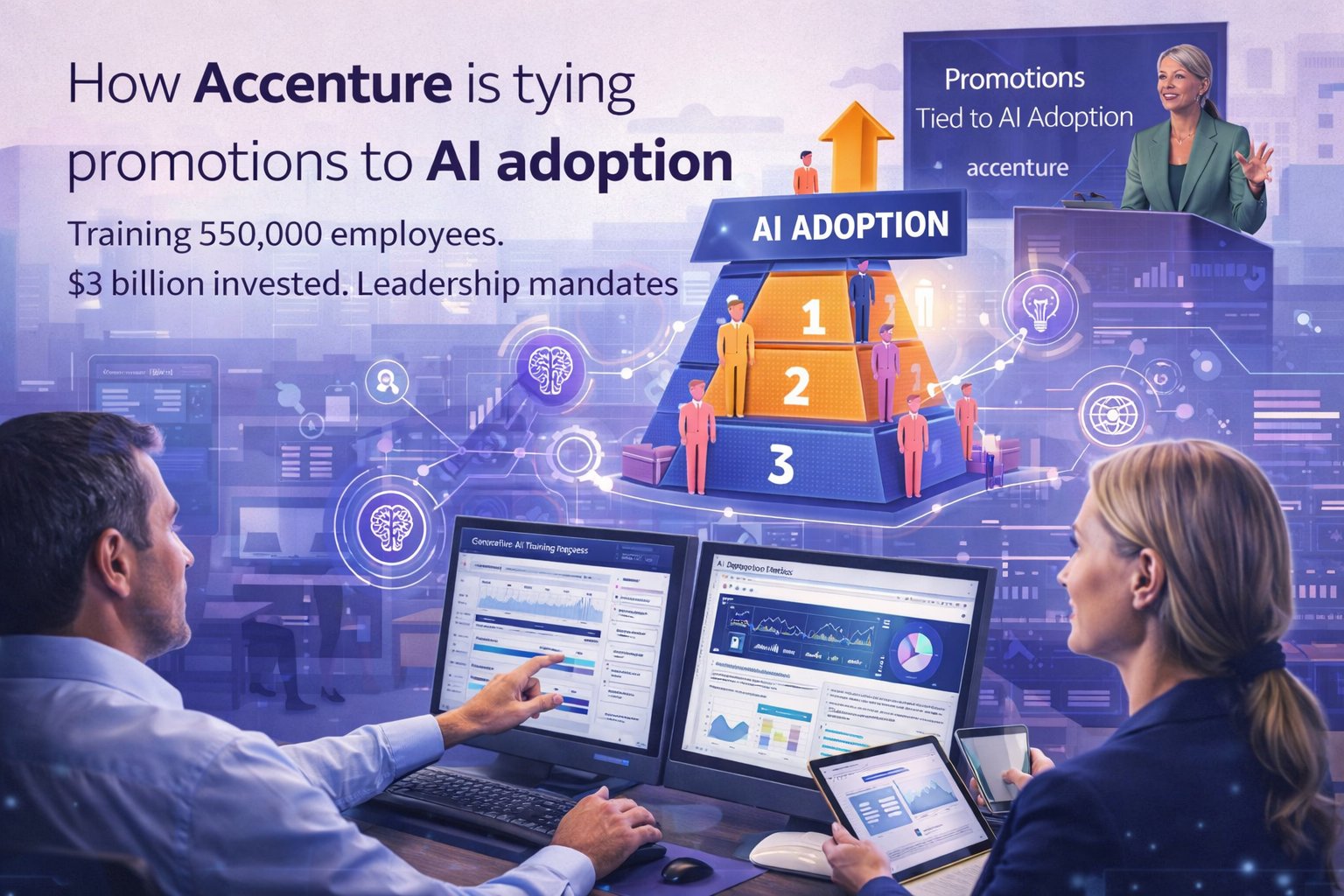
Accenture has done something that most businesses haven't had the courage, or the budget, to do. Over the past three years, the Dublin-headquartered consulting giant has invested $3 billion in AI integration. It has trained 550,000 of its 780,000 employees in generative AI. And now it's tying promotions to whether people actually use them.
In February, Accenture told its associate directors and senior managers that "regular adoption" of AI tools would be required for promotion to leadership positions. The company has started tracking weekly log-ins. CEO Julie Sweet went further, saying the company would be "exiting" staff who can't be retrained for the skills the business needs.
Accenture isn't alone. KPMG announced that AI usage will form part of annual performance reviews starting this year. Meta has made "AI-driven impact" a core expectation for all employees in 2026. The direction of travel is clear.
But here's the part of this story that most commentary has missed, and the part that matters most for any business thinking about how to train its own people.
Training 550,000 people is impressive. It's also not enough.
Accenture itself has acknowledged the gap. Despite training 70% of its workforce on generative AI, adoption has been uneven. Senior employees, in particular, have been slower to change how they work. The Financial Times reported that persuading partners and senior managers to use the tools has been described by executives as an exercise in "chivvying." One person familiar with the changes described some of the internal tools as, frankly, not fit for purpose.
This mirrors a pattern we see across every industry. Organisations invest in training. People complete the training. And then nothing changes.
Gallup's most recent data confirms this. As of the end of 2025, daily AI usage in the workplace sits at just 12%. The Google/Ipsos research found that only 5% of workers qualify as genuinely "AI fluent", meaning they've actually redesigned meaningful parts of their work around AI, not just used a chatbot to draft an email.
The training happened. The adoption didn't.
The gap isn't knowledge. It's design.
This is the distinction that makes all the difference, and it's the one most organisations miss.
There's a fundamental difference between training someone on what a tool does and training someone to change how they work. The first is information. The second is behaviour change. And behaviour change requires a completely different kind of learning design.
Information-based training, here's the tool, here's how it works, here's a quiz, is relatively easy to build and deploy at scale. It produces impressive completion numbers. It satisfies the requirement to say "we trained our people."
But it doesn't change what people do on Monday morning.
Behaviour change requires practice. It requires scenarios that mirror real work. It requires people to make decisions, get feedback, and try again. It requires learning that's connected to the specific context of each role, what does an account manager need to do differently? A project lead? A compliance officer? The answer is different for each one, and generic AI training doesn't address any of them.
What this means for businesses without Accenture's budget
If the world's largest consulting firm, spending $1 billion a year on learning and development, still struggles with adoption, what does that tell the rest of us?
It tells us that scale doesn't solve the problem. Budget doesn't solve the problem. Even executive mandates don't fully solve the problem.
What solves the problem is learning that's designed for behaviour change from the outset.
The organisations that are actually seeing AI adoption tend to share a few things in common:
They start with the work, not the tool. Instead of asking "how do we train people on AI?", they ask "what does this role need to look like in six months, and what does this person need to learn to get there?"
They design learning around practice, not content. The most effective programmes put people in realistic scenarios where they use AI to solve problems they actually face, and give them feedback on how they did.
They build learning into the flow of work. Not a separate platform they have to log into. Not a two-day workshop they attend and forget. Learning that's embedded in daily routines, delivered in short, focused modules, reinforced over time.
And they measure behaviour, not completion. Not "did they finish the course?" but "did anything change in how they work?"
What this means for a professional body's CPD
An employer can teach its staff the tool. Accenture has, 550,000 times over. What an employer cannot teach is the duty that travels with a member from one job to the next: what an accountant, a solicitor, an actuary or a surveyor owes a client when AI has touched the work. That duty belongs to the profession, and it is a professional body's CPD that has to carry it.
The same pattern shows in the two large employer programmes that followed. Santander made AI training mandatory for all 185,000 staff. PwC's Learning Collective names 30 skills, 15 of them human, and never teaches an AI skill on its own. Both are employers teaching their own staff their own tools, and neither can set what a profession expects of its members. Both also point the same way as Accenture: the tool is the easy half, and judgement is the half that has to be practised.
For a professional body, three things follow. Members' CPD on AI should be built on decisions, not on recall. It should fit the body's own competence framework and code of conduct, not a generic course. And it should leave evidence of how a member decided, not only that they finished. The legal floor is already in place: Article 4 of the EU AI Act has required AI literacy since 2 February 2025, and the standard for what counts as adequate training is rising elsewhere too, as the UK's Employment Rights Act shows for compliance training.
This is what AI for Professional Practice was built to do. Module 1 is open to anyone, takes about twenty minutes and needs no sign-up. It puts three real situations in front of a member and scores how they decide. A professional body can license the CPD programme under its own name.
Where LearnFrame fits
This is the work we do at LearnFrame, and it's the work we've been doing for over 30 years, long before AI was part of the conversation.
The tools have changed. The core challenge hasn't. How do you design learning that actually changes what people do?
We help organisations build digital learning programmes that are designed for behaviour change, structured around specific roles, built with practice and feedback at the centre, and measured by outcomes that matter to the business.
We work with organisations of every size. You don't need Accenture's budget to get this right. You need the right design, the right strategy, and a partner who's done this before.
If the Accenture story has made you think about how your own organisation is approaching training, whether that's AI adoption, onboarding, compliance, or any other area where you need people to actually change how they work, we'd welcome that conversation.
Weighing a decision like this on one of your own programmes? The Programme Design Diagnostic is a fixed-fee, independent read on a single programme, a board-ready diagnosis and a costed build scope, in two to three weeks.